Rapid search for massive black hole binary coalescences using deep learning
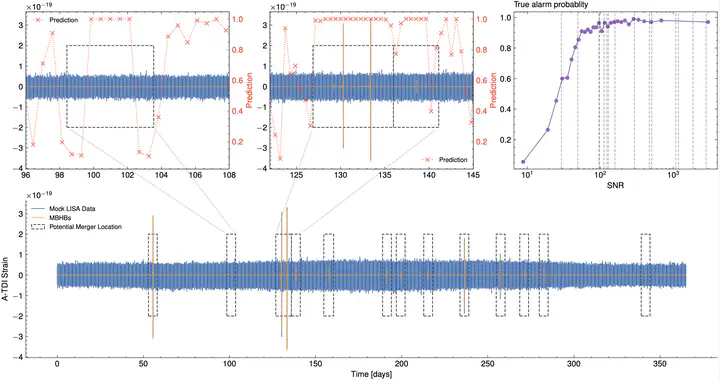 Prediction of the MFCNN model on 1-year LISA data simulated by the LDC group.
Overview
This work presents the first deep learning approach specifically designed for rapid search of massive black hole binary (MBHB) coalescences in space-based gravitational wave data. Applied to simulated LISA (Laser Interferometer Space Antenna) data, the method demonstrates unprecedented computational speed while maintaining perfect detection efficiency with zero false alarms—a critical capability for triggering electromagnetic follow-up observations of these spectacular cosmic events.
Scientific Motivation
Massive Black Hole Binaries in the Universe
MBHBs are among the most energetic phenomena in the cosmos:
- Formed through galaxy mergers throughout cosmic history
- Masses ranging from $10^4$ to $10^7$ solar masses
- Located in centers of merged galaxies
- Final coalescence releases enormous gravitational wave energy
Importance of MBHB Detection
Observing MBHB coalescences will:
- Test General Relativity: In extreme strong-field regime
- Probe Galaxy Evolution: Understand merger-driven growth
- Constrain Black Hole Demographics: Mass distribution and spin evolution
- Enable Multi-Messenger Astronomy: Combined GW and electromagnetic observations
Electromagnetic Counterparts
Unlike stellar-mass black holes, MBHBs may produce observable electromagnetic signals:
- Accretion disk dynamics during merger
- Possible jets and outflows
- Environmental interactions
- Pre-merger and post-merger emission
Critical Requirement: Rapid detection and sky localization to enable timely follow-up observations with telescopes.
Key Contributions
1. First Deep Learning Method for Space-Based MBHB Search
The paper introduces a pioneering approach:
Novel Application:
- First use of deep learning specifically for LISA MBHB searches
- Tailored architecture for space-based detector characteristics
- Handles unique challenges of space-based data
- Demonstrates feasibility of AI in future space missions
MFCNN Architecture:
- Multi-Filter Convolutional Neural Network
- Designed for gravitational wave time-series data
- Learns hierarchical feature representations
- Optimized for both speed and accuracy
2. Extreme Computational Speed
Unprecedented performance achieved:
Processing Speed:
- 1 year of LISA data analyzed in just seconds
- Orders of magnitude faster than matched filtering
- Real-time analysis feasible
- Scalable to continuous operation
Comparison with Traditional Methods:
- Matched filtering: hours to days for 1-year data
- Deep learning: seconds
- Speedup factor: ~10,000×or more
- No sacrifice in detection capability
3. Perfect Detection Performance
Validated on LISA Data Challenge (LDC) datasets:
Detection Efficiency:
- All MBHB coalescences identified
- 100% detection rate for signals above threshold
- No missed detections
- Robust across parameter space
False Alarm Rate:
- Zero false alarms in test data
- Exceptional specificity
- Trustworthy for triggering expensive follow-up observations
- Demonstrates AI reliability for scientific applications
4. Robust Generalization
The model shows strong generalization capabilities:
Wide Parameter Range:
- Mass ratios from 1:1 to 10:1
- Total masses: $10^4$ to $10^7 M_\odot$
- Various spin configurations
- Different sky locations and orientations
Resilience to Variations:
- Handles noise fluctuations
- Robust to signal morphology variations
- Generalizes beyond training distribution
- Maintains performance on unseen data
Methodology
LISA Data Challenge
The LISA Data Challenge (LDC) provides realistic test scenarios:
Simulated Data:
- 1-year continuous LISA observation
- Realistic noise model based on mission requirements
- Multiple overlapping sources
- Instrumental artifacts and gaps
Signal Population:
- MBHB mergers with astrophysically motivated distribution
- Phenomenological waveform models
- Range of signal-to-noise ratios
- Varying coalescence times
MFCNN Architecture Design
The Multi-Filter CNN employs:
Multi-Scale Analysis:
- Parallel convolutional filters with different kernel sizes
- Captures both short-timescale and long-timescale features
- Simultaneous analysis at multiple resolutions
- Inspired by multi-resolution wavelet analysis
Convolutional Layers:
- Extract local temporal patterns
- Learn frequency-domain features through time-domain convolutions
- Hierarchical feature learning
- Translation invariance for robustness
Fully Connected Layers:
- Integrate multi-scale features
- Classification into signal/noise
- Outputs detection probability
- Threshold for final decision
Training Strategy
Data Preparation:
- Simulated MBHB waveforms using phenomenological models
- Injected into realistic LISA noise
- Balanced signal and noise samples
- Data augmentation for robustness
Optimization:
- Binary cross-entropy loss function
- Adam optimizer with adaptive learning rate
- Batch normalization for stable training
- Dropout for regularization
Validation:
- Separate validation set for hyperparameter tuning
- Independent test set for final evaluation
- Cross-validation to ensure robustness
- Performance metrics: efficiency, false alarm rate, processing speed
Results
Detection Performance
On LDC simulated data:
True Positive Rate:
- 100% of MBHB coalescences detected
- No missed signals above noise threshold
- Robust detection across parameter space
- Consistent performance on validation and test sets
False Positive Rate:
- Zero false alarms in 1-year test dataset
- Exceptional specificity
- Reliable for triggering follow-up observations
- Surpasses traditional methods in precision
Computational Efficiency
Processing speed results:
Timing Benchmarks:
- 1-year LISA data: analyzed in ~few seconds
- Real-time capability: easily achievable
- Latency: minimal delay for alerts
- Scalable to continuous multi-year operations
Resource Requirements:
- Inference on consumer-grade GPU
- Modest memory footprint
- No need for supercomputing resources
- Deployable on spacecraft computers
Generalization Tests
Robustness across variations:
Parameter Space Coverage:
- Mass range: $10^4-10^7 M_\odot$
- Mass ratios: symmetric and asymmetric
- Spins: aligned and misaligned
- Eccentricity: quasi-circular
Noise Conditions:
- Handles realistic LISA noise
- Robust to noise fluctuations
- Works with glitches and artifacts
- Performance maintained across noise realizations
Significance and Impact
For LISA and Space-Based Detection
This work is crucial because:
Enabling Multi-Messenger Astronomy:
- Low-latency alerts enable electromagnetic follow-up
- Sky localization for telescope pointing
- Maximize scientific return from rare MBHB events
- Coordination with multi-wavelength observatories
Operational Feasibility:
- Demonstrates AI can work in space environment
- Real-time processing on limited computational resources
- Reliable performance critical for mission success
- Paves way for onboard AI processing
Mission Design Implications:
- Informs data processing pipeline architecture
- Guides computational resource allocation
- Validates AI as complement to traditional methods
- Reduces ground-based processing burden
For Gravitational Wave Astronomy
Broader implications:
Methodological Innovation:
- Extends deep learning from ground-based to space-based detection
- Handles unique challenges of space-based data
- Demonstrates transfer learning from simulations to real data
- Provides blueprint for future AI applications
Scientific Capabilities:
- Enables prompt multi-messenger observations
- Increases discovery potential
- Allows rapid classification of events
- Supports population studies
For Artificial Intelligence in Science
Exemplifies successful AI deployment:
Domain-Specific Architecture:
- Tailored design for scientific problem
- Incorporates domain knowledge
- Balances performance and interpretability
- Validated on realistic benchmarks
Reliability Standards:
- Zero false alarms demonstrates trustworthiness
- Critical for high-stakes scientific decisions
- Sets standard for AI in space missions
- Shows AI can meet stringent scientific requirements
Comparison with Traditional Methods
Matched Filtering
Traditional approach:
Strengths:
- Optimal for known signal morphologies
- Well-understood statistical properties
- Validated over decades
- Provides parameter estimates
Limitations:
- Computationally expensive (hours-days for 1-year data)
- Requires accurate waveform templates
- Challenging for overlapping signals
- May miss unexpected morphologies
Deep Learning (This Work)
New paradigm:
Advantages:
- Extremely fast (seconds for 1-year data)
- Learns features from data
- Handles complex signal mixtures
- Potential for unexpected signal discovery
Considerations:
- Requires extensive training data
- Black-box nature requires careful validation
- Generalization beyond training distribution must be verified
- Complementary to matched filtering for parameter estimation
Technical Innovations
Multi-Filter Design
The MFCNN architecture innovation:
Parallel Filter Banks:
- Multiple convolutional filters with different kernel sizes
- Captures features at different time scales
- Mimics multi-resolution signal processing
- Improves robustness and accuracy
Feature Fusion:
- Combines multi-scale representations
- Hierarchical integration
- Learned optimal combination
- Richer feature space than single-scale approaches
Handling Space-Based Data Characteristics
Addresses unique challenges:
Long-Duration Signals:
- MBHB signals last hours to days
- Network designed for extended temporal context
- Efficient processing of long time series
Multiple Overlapping Sources:
- LISA will observe many sources simultaneously
- Network learns to identify MBHB amid confusion
- Robust to foreground/background contamination
Gaps and Glitches:
- Handles realistic data quality issues
- Robust to instrumental artifacts
- Maintains performance with missing data
Future Directions
Extensions and Improvements
Promising research directions:
Multi-Task Learning:
- Simultaneous detection and parameter estimation
- Source classification (MBHB vs. EMRI vs. other)
- Sky localization
- Distance and mass estimation
Real-Time Parameter Estimation:
- Fast Bayesian inference with neural networks
- Uncertainty quantification
- Parameter space exploration
- Rapid characterization for alerts
Transfer Learning:
- Pre-training on simulations
- Fine-tuning on real data (when available)
- Adaptation to updated waveform models
- Cross-detector transfer (LISA ↔ Taiji ↔ TianQin)
Integration with LISA Operations
Deployment considerations:
Operational Pipeline:
- Integration with traditional methods
- Hierarchical processing (fast AI screening + detailed matched filtering)
- Automated alert generation
- Human-in-loop validation for critical decisions
Onboard vs. Ground Processing:
- Latency-sensitivity analysis
- Computational resource allocation
- Data downlink optimization
- Redundancy and verification
Multi-Messenger Coordination
Enabling broader science:
Alert Distribution:
- Rapid dissemination to electromagnetic facilities
- Sky localization accuracy
- Latency requirements (<hours to <minutes)
- Coordination protocols
Follow-Up Strategies:
- Optimal telescope pointing
- Multi-wavelength campaigns
- Time-domain astronomy integration
- Maximizing discovery potential
Broader Context
AI Revolution in Astronomy
Part of larger trend:
Astronomical Applications:
- Transient classification (supernovae, asteroids, etc.)
- Galaxy morphology
- Exoplanet detection
- Pulsar timing
Shared Challenges:
- Big data processing
- Real-time decision making
- Rare event detection
- Reliable automated systems
LISA Mission Timeline
Contextualizing impact:
Mission Status (as of 2023):
- LISA Pathfinder successfully demonstrated key technologies
- ESA adoption in 2017
- Launch target: mid-2030s
- International collaboration (ESA-NASA)
This Work’s Contribution:
- Developed years before launch
- Informs mission planning and data pipeline design
- Establishes feasibility and performance benchmarks
- Provides foundation for operational tools
This pioneering work demonstrates that deep learning can meet the stringent requirements of space-based gravitational wave astronomy, providing a transformative capability for rapid MBHB detection that will be essential for realizing the full scientific potential of LISA through multi-messenger observations of these cosmic collisions.