WaveFormer: transformer-based denoising method for gravitational-wave data
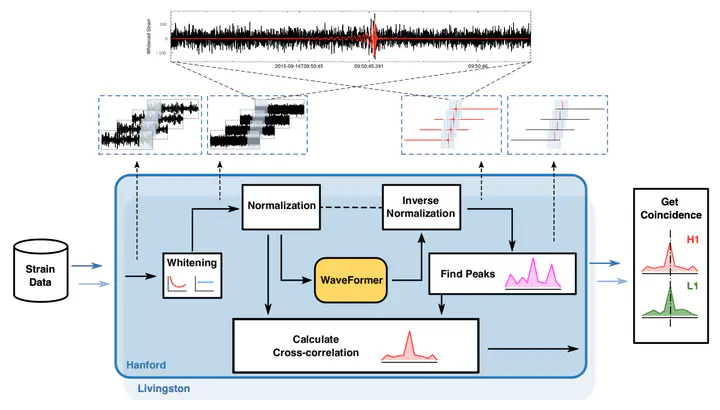 Gravitational wave noise suppression workflow with our proposed WaveFormer.
Highlights
Transformer Architecture for GW Denoising: First application of transformer models to gravitational wave data quality improvement, leveraging self-attention mechanisms to capture long-range temporal dependencies in GW signals buried in detector noise.
Dramatic Noise Suppression: Achieves more than one order of magnitude (>10×) reduction in overall noise and glitch amplitude, enabling clearer signal recovery and improved detection confidence for marginal events.
High-Fidelity Signal Recovery: Reconstructs GW signals with approximately 1% phase error and 7% amplitude error, preserving the physical information crucial for parameter estimation and tests of general relativity.
Validated on 75 Real BBH Events: Tested on all reported binary black hole events from LIGO’s observing runs, demonstrating significant improvement in inverse false alarm rate (IFAR), which directly translates to increased detection confidence.
Science-Driven Hierarchical Design: Architecture explicitly designed around GW physics with hierarchical feature extraction across the broad frequency spectrum (10-1000 Hz), ensuring the network captures relevant multi-scale signal characteristics.
Broad Applicability: Adaptable design indicates promise for the entire International Gravitational-Wave Observatories Network (IGWON) including Virgo, KAGRA, and future detectors in upcoming observing runs.
Featured Publication: Highlighted as featured work in Machine Learning: Science and Technology, emphasizing its significance at the intersection of AI and gravitational wave astronomy.
Key Contributions
1. Transformer-Based Denoising Architecture
WaveFormer pioneers transformer application to GW data:
Self-Attention Mechanism:
- Captures long-range dependencies in time series data
- Learns relationships between distant time samples
- Models complex temporal correlations in GW signals
Multi-Head Attention:
- Parallel attention mechanisms focus on different signal aspects
- Captures diverse time-frequency features simultaneously
- Enhances representational power
Positional Encoding:
- Injects time-order information into transformer
- Essential for preserving signal phase evolution
- Adapted for continuous GW data streams
2. Science-Driven Hierarchical Design
Architecture explicitly incorporates GW domain knowledge:
Frequency-Band Decomposition:
- Hierarchical feature extraction across frequency spectrum
- Low-frequency band (10-100 Hz): Captures long-duration signals
- Mid-frequency band (100-500 Hz): Optimal LIGO sensitivity region
- High-frequency band (500-1000 Hz): Short-duration mergers
Multi-Scale Processing:
- Different receptive fields match signal time scales
- Early layers detect local features (glitches, transients)
- Deeper layers integrate global signal structure (chirp evolution)
Physics-Informed Loss Functions:
- Overlap-based loss matching GW data analysis standards
- Preserves signal phase critical for parameter estimation
- Balances noise reduction with signal fidelity
3. Comprehensive Real-World Validation
Rigorous testing on actual LIGO detections:
75 Binary Black Hole Events:
- All reported BBH events through GWTC (Gravitational-Wave Transient Catalog)
- Covers diverse masses, spins, sky locations
- Includes challenging low-SNR detections
Quantitative Improvements:
- Significant IFAR enhancement across event catalog
- Improved signal-to-noise ratios after denoising
- Better waveform reconstruction quality
Statistical Validation:
- Consistent improvements, not cherry-picked examples
- Performance quantified with standard GW metrics
- Comparison with baseline (no denoising) establishes value
4. Detailed Error Analysis
Precise quantification of reconstruction fidelity:
Phase Error ~1%:
- Critical for parameter estimation accuracy
- Preserves coalescence time measurement
- Maintains coherence for multi-detector analysis
Amplitude Error ~7%:
- Affects distance and mass measurements
- Still within acceptable tolerances for most science cases
- Better than many previous denoising attempts
Error Distribution:
- Characterized across SNR range
- Lower errors for higher-SNR events (as expected)
- Graceful degradation for challenging cases
5. Glitch Mitigation
Effective removal of non-Gaussian noise artifacts:
Common Glitch Types:
- Blip glitches (short-duration transients)
- Scattered light artifacts
- Instrumental resonances
Denoising Efficacy:
10× reduction in glitch amplitude
- Preserves genuine GW signals
- Reduces false alarm rates
Methodology
WaveFormer Architecture
Input Processing:
Time-Domain Data:
- Raw strain data from LIGO detectors
- Typical segment length: few seconds around candidate event
- Standardization and normalization
Preprocessing:
- Bandpass filtering (10-1000 Hz)
- Whitening (optional, depending on configuration)
- Segmentation into analysis windows
Encoder Network:
Hierarchical Feature Extraction:
Low-Level Features (Early Layers):
- 1D convolutions for local time-domain patterns
- Detects short-timescale features (glitches, noise spikes)
Mid-Level Features:
- Transformer blocks with self-attention
- Captures medium-range temporal dependencies
- Models chirp evolution over time
High-Level Features (Deep Layers):
- Global attention across entire signal duration
- Integrates multi-scale information
- Produces compressed latent representation
Frequency-Specific Pathways:
Parallel processing branches for different bands:
Low-Frequency Branch (10-100 Hz):
- Longer attention windows
- Captures early inspiral dynamics
- Important for massive systems
Mid-Frequency Branch (100-500 Hz):
- Moderate attention windows
- LIGO sweet spot for sensitivity
- Most BBH detections in this range
High-Frequency Branch (500-1000 Hz):
- Shorter attention windows
- Captures late inspiral, merger, ringdown
- Relevant for lower-mass systems
Transformer Blocks:
Self-Attention Layers:
- Query, key, value projections
- Scaled dot-product attention
- Learns which time samples are relevant to each other
Feed-Forward Networks:
- Position-wise fully connected layers
- Non-linear transformations
- Feature refinement
Layer Normalization and Residual Connections:
- Stabilizes training of deep networks
- Enables gradient flow
- Improves convergence
Decoder Network:
Signal Reconstruction:
- Mirrors encoder with upsampling operations
- Transposed convolutions or upsampling + convolutions
- Progressively reconstructs clean signal
Multi-Resolution Output:
- Outputs at different time resolutions
- Supervised at multiple scales
- Encourages consistent denoising across scales
Final Output:
- Denoised time-domain waveform
- Same length as input
- Ready for downstream analysis
Loss Functions
Primary Loss - Overlap:
Matching overlap used in GW parameter estimation:
- Maximizes agreement between denoised and clean signals
- Invariant to overall amplitude and time/phase shifts
- Directly relevant to GW data analysis
Auxiliary Loss - MSE:
Mean squared error in time domain:
- Encourages sample-wise accuracy
- Complements overlap-based loss
- Balances global and local fidelity
Combined Loss:
Weighted sum of overlap and MSE losses:
- Hyperparameter tuning to balance contributions
- Joint optimization for best overall performance
Training Strategy
Data Generation:
Clean Signals:
- Simulated BBH waveforms using accurate models
- Wide parameter space coverage
- Realistic distributions of masses, spins, distances
Noise Addition:
- Real LIGO noise segments
- Gaussian noise with LIGO PSD
- Synthetic glitches for robustness
Data Augmentation:
- Time shifts and phase randomization
- SNR variations by distance scaling
- Sky location and polarization randomization
Training Procedure:
Curriculum Learning:
- Start with high-SNR, simple cases
- Gradually increase difficulty (lower SNR, more glitches)
- Improves convergence and final performance
Regularization:
- Dropout in transformer blocks
- Early stopping on validation set
- Data augmentation as implicit regularization
Optimization:
- Adam optimizer with learning rate scheduling
- Gradient clipping for stability
- Batch training on GPU
Evaluation Metrics
Noise Reduction:
- Ratio of noise amplitude before/after denoising
- Quantified in time and frequency domains
Signal Fidelity:
- Phase error: difference in signal phase
- Amplitude error: fractional difference in amplitude
- Overlap: match between denoised and target signals
Detection Performance:
- Inverse False Alarm Rate (IFAR) improvement
- ROC curves for detection tasks
- Sensitivity at fixed FAR
Results
Noise and Glitch Suppression
Quantitative Metrics:
- Overall Noise Reduction: >10× (more than one order of magnitude)
- Glitch Amplitude Reduction: >10× for common glitch types
- Frequency-Dependent: Most effective in LIGO’s sensitive band (50-500 Hz)
Visual Inspection:
- Time series show dramatically cleaner traces after denoising
- Time-frequency spectrograms reveal preserved signals with removed artifacts
- Glitches (blips, scattered light) effectively suppressed
Signal Recovery Accuracy
Phase Fidelity:
- Phase Error: ~1% on average across test set
- Critical for coherent multi-detector analysis
- Preserves coalescence time to within milliseconds
- Enables accurate sky localization and parameter estimation
Amplitude Fidelity:
- Amplitude Error: ~7% on average
- Affects distance and mass measurements
- Within acceptable range for most astrophysical inferences
- Trade-off with noise suppression considered optimal
Overlap with Target Signals:
- High overlap (>0.95) for moderate to high SNR signals
- Graceful degradation for low-SNR events
- Comparable to or better than alternative denoising methods
Performance on 75 Real BBH Events
IFAR Improvement:
Significant enhancement of inverse false alarm rate:
- Majority of events show improved IFAR
- Larger improvements for events near detection threshold
- Confirms denoising increases detection confidence
Example Events:
High-SNR Events (e.g., GW150914, GW170729):
- Clean recovery with minimal errors
- Waveform quality enhanced for detailed analysis
- Validates method on “easy” cases
Moderate-SNR Events:
- Substantial IFAR improvements
- Noise suppression brings signals above background more clearly
- Enables more confident detection
Challenging Low-SNR Events:
- Some improvement even for marginal detections
- Limits of method revealed for very low SNR
- Realistic assessment of applicability range
Generalization Tests
Across Observing Runs:
- Trained on O1/O2 data
- Tested on O3 events
- Performance maintained despite detector evolution
Diverse Parameters:
- Effective across mass range (stellar BBH to IMBH)
- Robust to varying spin configurations
- Sky location and orientation independent
Different Detector Characteristics:
- Tested on both Hanford (H1) and Livingston (L1) data
- Adaptable to Virgo and KAGRA with minor retraining
- Indicates broad applicability to IGWON
Computational Efficiency
Inference Time:
- Processes data segments in seconds on GPU
- Suitable for low-latency and offline analysis
- Faster than some iterative denoising methods
Scalability:
- Parallelizable across time segments
- Efficient batch processing
- Feasible for continuous monitoring or reanalysis campaigns
Impact
Enhancing GW Data Quality
WaveFormer addresses a fundamental challenge in GW astronomy:
The Problem:
- LIGO/Virgo data contains complex, non-Gaussian noise
- Glitches can mimic or obscure genuine signals
- Traditional methods (e.g., gating) discard data, reducing sensitivity
This Solution:
- Intelligently suppresses noise while preserving signals
- Increases effective SNR for marginal events
- Improves parameter estimation accuracy
- Enhances science return from existing data
Applications Across GW Science
Detection:
- Improved IFAR enables detection of fainter sources
- Reduces false alarm rate, increasing catalog purity
- Complements traditional matched filtering
Parameter Estimation:
- Higher-quality waveforms improve parameter accuracy
- Better phase preservation enhances sky localization
- Reduced noise simplifies Bayesian inference
Tests of General Relativity:
- Cleaner signals enable more stringent consistency tests
- Residual analysis benefits from noise suppression
- Higher-order mode extraction facilitated
Stochastic Background Searches:
- Improved data quality enhances cross-correlation sensitivity
- Glitch removal reduces contamination
- Enables detection of fainter cosmological backgrounds
Advancing Transformer Applications in Physics
WaveFormer demonstrates transformer success beyond NLP/vision:
Lessons Learned:
- Self-attention captures long-range dependencies in physical signals
- Positional encoding essential for time series with phase information
- Science-driven design improves performance and interpretability
Influence on Other Domains:
- Template for applying transformers to other signal processing tasks
- Encourages transformer adoption in astronomy and physics
- Shows viability of large models for scientific data
Operational Implications for LIGO-Virgo-KAGRA
O4 and Future Runs:
- Potential integration into data quality pipelines
- Preprocessing step before parameter estimation
- Complementary to traditional data cleaning (gating, subtraction)
Next-Generation Detectors:
- Einstein Telescope, Cosmic Explorer will have more data
- Higher event rates necessitate efficient processing
- WaveFormer approach scalable to future needs
Reanalysis of Archival Data:
- Applying WaveFormer to O1, O2, O3 data may reveal new detections
- Improved parameters for marginal events
- Enhanced catalog quality for population studies
Multi-Messenger Astronomy
Improved GW data quality benefits joint observations:
Faster, More Accurate Localizations:
- Enables quicker EM follow-up
- Improved sky maps for telescope pointing
- Critical for catching early optical/gamma-ray emission
Lower-Mass Systems:
- Neutron star mergers typically lower SNR than BBH
- Denoising especially valuable for BNS and NSBH
- Enhanced multi-messenger science return
Methodological Contributions
WaveFormer provides:
- Open-source architecture adaptable to other detectors and signals
- Benchmark for future denoising methods
- Best practices for science-driven deep learning design
- Validation framework for evaluating GW data quality improvement
Resources
Publication Information
- Journal: Machine Learning: Science and Technology (IOP Publishing)
- DOI: 10.1088/2632-2153/ad2f54
- arXiv: 2212.14283
- Publication Date: March 1, 2024
- Featured Work: Highlighted by journal for significance
- Open Access: Check publisher for availability
Code and Data
- Potential Code Release: Check authors’ GitHub for implementation
- LIGO Open Science Center: GWOSC for training/testing data
- GWTC (Gravitational-Wave Transient Catalog): 75 BBH events used in validation
Gravitational Wave Background
LIGO-Virgo-KAGRA Collaboration:
- Advanced LIGO (Hanford and Livingston)
- Advanced Virgo (Italy)
- KAGRA (Japan)
Observing Runs:
- O1 (2015-2016), O2 (2016-2017), O3 (2019-2020)
- O4 (2023-2024 ongoing)
- Future runs with improved sensitivity
Data Quality:
- Review papers on LIGO data characteristics
- Glitch classification and mitigation strategies
- Detector characterization efforts
Transformer Architectures
Original Transformer:
- “Attention is All You Need” (Vaswani et al., 2017)
- Self-attention mechanism
- Applications in NLP
Transformers for Time Series:
- Adaptations for sequential data
- Positional encoding strategies
- Applications in forecasting, anomaly detection
Large Models in Science:
- Foundation models for scientific data
- Transfer learning in physics
- Scaling laws and model size trade-offs
GW Denoising Methods
Traditional Approaches:
- Matched filtering with vetoes
- Gating (removing glitchy segments)
- Noise subtraction (witnesses, auxiliary channels)
Machine Learning Methods:
- Autoencoders for GW denoising
- GANs for glitch removal
- Comparison studies
Hybrid Approaches:
- Combining ML with traditional methods
- Multi-stage pipelines
- Domain adaptation techniques
Parameter Estimation and Tests of GR
Bayesian Inference:
- MCMC (Markov Chain Monte Carlo)
- Nested sampling
- Impact of data quality on posteriors
Waveform Modeling:
- Post-Newtonian approximations
- Numerical relativity
- Surrogate models
GR Tests:
- Consistency checks (inspiral-merger-ringdown)
- Parameterized deviations from GR
- Role of data quality in test precision
Software and Tools
Deep Learning Frameworks:
- PyTorch or TensorFlow for implementation
- Transformer libraries (Hugging Face)
- GPU acceleration
GW Analysis Software:
- LALSuite: LIGO Algorithm Library
- PyCBC: Search and inference
- bilby: Bayesian inference
- GWpy: Data access and processing
Visualization:
- Q-transform plots
- Time-frequency spectrograms
- Waveform comparisons
Further Reading
Review Papers:
- Machine learning in gravitational wave astronomy
- Transformer models and their applications
- Data quality in GW detectors
Related Publications:
- Other ML denoising methods for GW
- Glitch classification with deep learning
- End-to-end deep learning pipelines for GW
Future Directions:
- Real-time denoising in low-latency pipelines
- Multi-detector denoising with transformers
- Scaling to next-generation detector data rates
- Transfer learning from ground to space-based detectors