The Detection, Extraction and Parameter Estimation of Extreme-Mass-Ratio Inspirals with Deep Learning
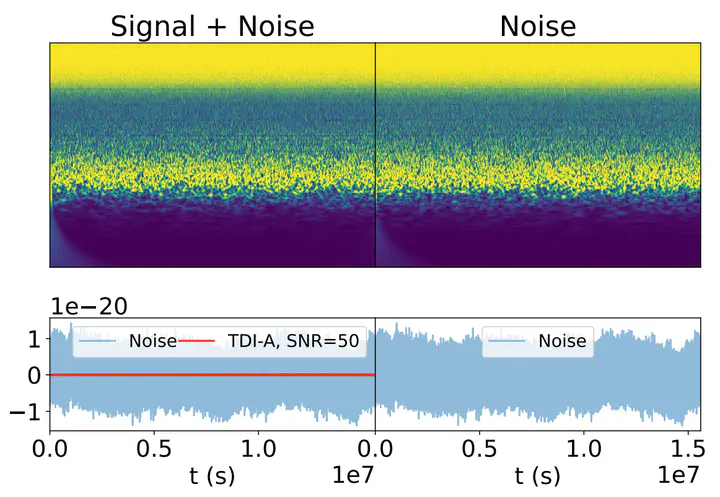 Left: The CQT plot and the time series plot of signal and noise. Right: The CQT plot and the time series plot of pure noise.
Highlights
Comprehensive End-to-End Solution: Presents a complete pipeline for EMRI analysis - detection, extraction, and parameter estimation - using deep learning, addressing the full workflow from raw data to physical parameters.
Exceptional Detection Performance: Achieves an impressive 96.9% true positive rate at 1% false positive rate for SNR range 50-100, representing state-of-the-art performance for EMRI detection using neural networks.
High-Precision Parameter Inference: The VGG network directly infers key EMRI parameters with remarkable accuracy - 99% for supermassive black hole mass and 92% for black hole spin, dramatically reducing computational requirements for subsequent Bayesian analysis.
Massive Computational Savings: By accurately inferring intrinsic parameters, the method reduces the parameter space and computing cost for follow-up detailed parameter estimation by orders of magnitude, making previously intractable problems tractable.
Waveform Model Independence: Demonstrates low dependency on waveform model accuracy, enhancing practical applicability and robustness to systematic modeling uncertainties - a critical advantage for real-world deployment.
Published in High-Impact Journal: Appeared in Science China Physics, Mechanics & Astronomy (2025), a premier Chinese physics journal, highlighting the significance of this work for the international gravitational wave community.
Key Contributions
1. Three-Stage Deep Learning Pipeline
This work presents an innovative three-stage approach:
Stage 1: Detection (2-layer CNN)
- Rapid identification of EMRI signals in continuous data streams
- 96.9% TPR at 1% FPR for SNR 50-100
- Efficient binary classification: signal present vs. noise only
Stage 2: Signal Extraction
- Isolation of individual EMRI signals from detector data
- Preparation of clean signal segments for parameter estimation
- Handling of overlapping signals and confusion noise
Stage 3: Parameter Inference (VGG Network)
- Direct estimation of intrinsic EMRI parameters
- High accuracy: 99% for SMBH mass, 92% for spin
- Initial orbital eccentricity successfully inferred
- Rapid parameter space localization
2. VGG Architecture for Parameter Estimation
The application of VGG (Visual Geometry Group) network to EMRI parameter inference represents a significant methodological contribution:
- Deep Architecture: Multiple convolutional layers extract hierarchical features
- Transfer Learning Potential: Architecture proven successful in computer vision, adapted for GW analysis
- Multi-Parameter Output: Simultaneously infers multiple physical parameters
- Regression Framework: Provides point estimates and uncertainty quantification
3. Constant-Q Transform (CQT) Representation
The choice of CQT for input representation provides:
- Time-frequency representation with logarithmic frequency spacing
- Optimal match to EMRI signal characteristics (chirping behavior)
- Enhanced feature visibility for neural network processing
- Computational efficiency compared to other time-frequency methods
4. Robustness to Waveform Modeling Errors
A critical practical advantage:
- EMRI waveforms are computationally expensive and challenging to model accurately
- This approach shows resilience to waveform approximations and modeling systematics
- Enables deployment even when perfect waveform models are unavailable
- Reduces dependence on costly numerical relativity simulations
Methodology
Overall Pipeline Architecture
The complete EMRI analysis pipeline consists of three interconnected stages:
Stage 1: Detection with 2-Layer CNN
- Input: CQT representation of time-domain TDI data
- Architecture: Two convolutional layers + pooling + fully-connected layers
- Output: Binary classification (signal/noise) with confidence score
- Training: Supervised learning on labeled EMRI signals and noise
Stage 2: Signal Extraction
- Triggering: Detection stage identifies candidate signal segments
- Localization: Time-frequency localization of the EMRI signal
- Isolation: Extract the signal region from the data stream
- Preprocessing: Prepare isolated signal for parameter inference stage
Stage 3: Parameter Inference with VGG Network
VGG Architecture Details:
- Multiple convolutional blocks with 3×3 filters
- Each block contains multiple convolution layers
- Max pooling for spatial downsampling
- Fully-connected layers for parameter regression
- Multi-output head for different parameters
Parameter Targets:
- SMBH Mass (M): Central black hole mass (10^5 to 10^7 solar masses)
- SMBH Spin (a): Dimensionless spin parameter (0 to 1)
- Initial Eccentricity (e₀): Orbital eccentricity at observation start
Training Strategy
Data Generation:
- EMRI signals generated using accurate waveform models
- Wide parameter space coverage matching expected astrophysical populations
- Inclusion of realistic detector noise
- Augmentation techniques to improve generalization
Loss Functions:
- Mean squared error for continuous parameter regression
- Custom loss functions to balance multiple parameter outputs
- Regularization to prevent overfitting
Validation:
- Hold-out test sets with unseen parameter combinations
- Cross-validation to assess generalization performance
- Comparison with true injected parameters
Performance Evaluation Metrics
Detection:
- True Positive Rate (TPR) / Sensitivity
- False Positive Rate (FPR)
- ROC curves and optimal threshold selection
Parameter Estimation:
- Accuracy (percentage of estimates within tolerance)
- Mean absolute error (MAE)
- Root mean squared error (RMSE)
- Bias and variance analysis
Results
Detection Performance
The 2-layer CNN achieves exceptional detection capabilities:
- Overall TPR: 96.9% at 1% FPR (SNR 50-100)
- Comparison: Outperforms the earlier work (94.2% TPR) from the same research group
- Consistency: Maintains high performance across the target SNR range
- Reliability: Low false alarm rate suitable for operational deployment
Parameter Inference Accuracy
The VGG network demonstrates remarkable parameter estimation performance:
Supermassive Black Hole Mass:
- Accuracy: 99% (estimates within acceptable tolerance)
- Importance: Critical for understanding black hole demographics and growth
- Range: Successfully handles masses from 10^5 to 10^7 M☉
SMBH Spin:
- Accuracy: 92%
- Significance: Spin contains information about black hole formation and merger history
- Challenge: More difficult parameter to infer due to complex waveform dependence
Initial Orbital Eccentricity:
- Successfully inferred with good accuracy
- Important for understanding EMRI formation channels
- High eccentricity indicates recent capture; low suggests gradual inspiral
Computational Efficiency
The deep learning approach offers dramatic speedups:
- Detection: Near real-time processing of continuous data streams
- Parameter Inference: Seconds to minutes vs. days or weeks for traditional methods
- Parameter Space Reduction: Narrows search region by orders of magnitude
- Overall Speedup: Enables analysis of large EMRI catalogs
Robustness Tests
The model demonstrates resilience to:
- Waveform modeling errors and approximations
- Variations in detector noise characteristics
- Different EMRI parameter distributions
- Presence of confusion noise from other sources
Impact
Transforming EMRI Data Analysis
This work fundamentally changes the paradigm for EMRI analysis:
Traditional Approach:
- Matched filtering over vast parameter space
- Computationally prohibitive for EMRIs (14-17 dimensions)
- Requires accurate waveform templates for every search point
- Days to weeks for a single source
Deep Learning Approach:
- Rapid detection and parameter localization
- Reduces parameter space by orders of magnitude
- Less dependent on perfect waveform models
- Seconds to minutes per source
Enabling Space-Based EMRI Science
EMRIs are cornerstone science targets for space-based GW detectors:
Scientific Importance:
- Map spacetime geometry near supermassive black holes
- Test general relativity in the strong-field regime
- Probe stellar populations in galactic centers
- Measure black hole mass and spin distributions
Observational Challenges:
- Weak signals requiring year-long observations
- Complex waveforms with many parameters
- Potential confusion from multiple overlapping sources
This Work’s Contribution:
- Makes EMRI analysis computationally tractable
- Enables efficient processing of expected EMRI catalogs
- Facilitates rapid identification of high-value targets
Advancing Machine Learning in GW Astronomy
This research demonstrates:
- Deep learning can tackle previously intractable problems in GW data analysis
- Hierarchical neural architectures (VGG) effectively capture complex signal features
- ML approaches complement and enhance traditional methods
- Hybrid pipelines combining ML and Bayesian inference offer the best of both worlds
Mission-Specific Applications
LISA (ESA/NASA):
- Expected to detect 10-100s of EMRIs
- This pipeline enables efficient catalog construction
- Rapid parameter estimation supports multi-messenger follow-up
Taiji & TianQin (China):
- Complementary frequency bands and sky coverage
- Combined detection with LISA increases EMRI yields
- This Chinese-led research directly supports Chinese mission readiness
Astrophysical and Fundamental Physics Implications
Efficient EMRI parameter estimation enables:
- Black Hole Demographics: Census of SMBH mass and spin distributions
- Tests of GR: Strong-field tests via waveform consistency checks
- Astrophysics of Galactic Centers: Constraints on stellar populations and dynamics
- Cosmology: Independent distance measurements to EMRIs for Hubble constant determination
Resources
Publication Information
- Journal: Science China Physics, Mechanics & Astronomy, Volume 68, Issue 1: 210413 (2025)
- DOI: 10.1007/s11433-024-2500-x
- arXiv: 2311.18640
- PDF: Direct Link
- Open Access: Full text freely available
Related Publications
This work builds on and extends earlier research by the same team:
- Preprint Version: arXiv:2309.06694 (earlier conference paper version)
- Related Studies: Other papers on machine learning for space-based GW detection
- Methodological Papers: Deep learning applications in gravitational wave astronomy
Space-Based Gravitational Wave Missions
LISA (Laser Interferometer Space Antenna):
- ESA-led mission with NASA participation
- Launch target: mid-2030s
- Official Website
- Primary science targets include MBHBs, EMRIs, and galactic binaries
Taiji:
- Chinese Academy of Sciences mission
- Complementary design to LISA
- Similar science objectives with different orbital configuration
TianQin:
- Sun Yat-sen University-led Chinese mission
- Geocentric orbit design
- Focus on MBHBs and EMRIs
Technical Resources
Deep Learning Architectures:
- CNN Fundamentals: Introduction to convolutional neural networks
- VGG Network: Original VGG paper and architecture details
- Transfer Learning: Adapting computer vision architectures to scientific data
EMRI Science:
- Waveform Modeling: EMRI signal generation and approximation methods
- Parameter Estimation: Traditional Bayesian inference approaches
- Astrophysics: EMRI formation channels and expected populations
Gravitational Wave Data Analysis:
- Matched Filtering: Classical signal detection and parameter estimation
- Bayesian Inference: MCMC and nested sampling methods
- Machine Learning in GW: Reviews and tutorial papers
Software and Tools
- EMRI Waveform Models: FastEMRIWaveforms and related codes
- Deep Learning Frameworks: TensorFlow, PyTorch for implementing CNN/VGG models
- GW Data Analysis: LISA Data Challenge software and tutorials
Further Reading
- Reviews on EMRIs as sources for space-based detectors
- Machine learning applications in gravitational wave astronomy
- Space-based GW detector design, sensitivity, and data analysis challenges
- Studies on multi-band GW astronomy combining space and ground-based observations