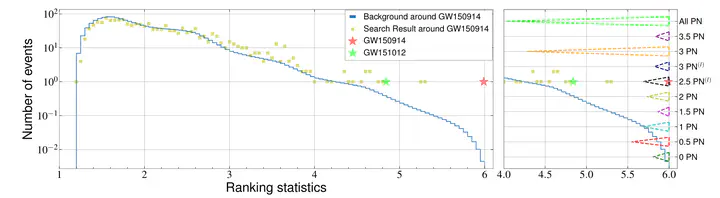
 (Left) Background noise analysis surrounding GW150914. The horizontal axis shows the metric values estimated by the model, while the vertical axis indicates the occurrence rate per year. The blue histogram represents the noise background estimation using time-shift analysis. The orange points mark candidate events, with the red and green stars indicating GW150914 and GW151012, respectively. (Right) Model output metrics after injecting PN deviations into GW150914. Different PN terms are represented on the vertical axis, with All PN incorporating all PN components. Isosceles triangles display the metric distribution, with the base representing the median and the vertex showing the minimum value. The analysis uses parameter sets where the luminosity distance is within the 1σ range of the median value [150].
Highlights
First Deep Learning Framework for Beyond-GR Detection: Pioneering application of neural networks specifically designed to detect gravitational wave signals that deviate from general relativity predictions.
Generalization Capability: Demonstrates that neural networks trained on GR-based templates can generalize to detect exotic signals from alternative theories of gravity through learned feature representations.
Comprehensive PN Testing: Evaluates detection performance across various post-Newtonian (PN) orders, providing systematic assessment of sensitivity to different types of GR deviations.
Computational Efficiency: Achieves rapid identification of exotic signals without the computational burden of exploring vast template spaces required by traditional methods.
GW150914 Application: Successfully validates the framework on real LIGO data, demonstrating practical applicability to actual gravitational wave events.
New Discovery Potential: Opens pathways for detecting previously overlooked beyond-GR signals that might escape traditional search pipelines constrained to GR templates.
Key Contributions
1. Addressing Template Space Limitations
Traditional gravitational wave searches face fundamental constraints:
- GR-Only Templates: Standard searches use waveform templates assuming strict adherence to general relativity
- Computational Infeasibility: Incorporating exotic signals from alternative gravity theories would require prohibitively vast template banks
- Potential Signal Loss: Subtle deviations from GR might be missed by GR-constrained pipelines
This work provides a solution by leveraging neural network generalization rather than explicit template coverage.
2. Deep Learning Architecture
The framework employs neural networks with:
- Feature Learning: Networks trained on GR templates learn intricate signal features that generalize beyond training distribution
- PN-Aware Design: Architecture capable of capturing post-Newtonian corrections at various orders
- Robust Detection: Maintains performance across different luminosity distances and signal strengths
3. Systematic Validation
Comprehensive testing framework including:
- Detection performance across various PN deviations (0PN, 0.5PN, 1PN, 1.5PN, 2PN, 2.5PN, 3PN, 3.5PN)
- Analysis at multiple luminosity distances
- Comparison with GR-based detection as baseline
- Real-event validation on GW150914 and GW151012
Methodology
Neural Network Training
Training Dataset
- GR-based waveforms covering binary black hole parameter space
- Various mass ratios, spins, and sky locations
- Realistic LIGO noise from actual detector data
- Signal-to-noise ratio coverage representative of detectable events
Network Architecture
- Deep convolutional layers for time-series feature extraction
- Multiple scales of temporal resolution through hierarchical processing
- Output classification for signal vs. noise discrimination
- Trained using supervised learning on labeled GR signals
Training Strategy
- Standard GR templates only (no exotic signals in training)
- Data augmentation including time shifts and amplitude variations
- Regularization to prevent overfitting
- Validation on held-out GR signals
Testing on Beyond-GR Signals
Post-Newtonian Deviations
- Systematic injection of various PN order modifications
- Deviations parameterized following modified gravity frameworks
- Range of deviation amplitudes tested
- Multiple PN orders evaluated independently and combined
Performance Metrics
- Detection efficiency as function of signal-to-noise ratio
- Comparison to GR-signal detection performance
- False alarm rate assessment using time-shifted noise analysis
- Distance reach for various deviation magnitudes
GW150914 Case Study
Application to the first detected gravitational wave event:
- Analysis using trained network on real LIGO data
- Injection of PN deviations into GW150914 parameters
- Metric value distribution for different PN modifications
- Comparison with actual event detection statistics
Results
Detection Performance
Generalization to Exotic Signals
- Neural networks successfully detect beyond-GR signals despite training only on GR templates
- Performance comparable to GR-signal detection across most PN orders
- Demonstrates effective feature learning that transcends specific theory assumptions
PN Order Sensitivity
- Detection efficiency varies by PN order but remains robust
- Some PN deviations detected more readily than others
- Combined PN modifications detected effectively
- Distance reach comparable to GR signals for moderate deviations
Computational Speed
- Rapid inference enabling real-time analysis
- Orders of magnitude faster than matched filtering with expanded template banks
- Suitable for low-latency alert generation
GW150914 Analysis
Background Noise Characterization
- Time-shift analysis establishes noise background distribution
- Clear separation between noise and signal candidates
- GW150914 stands out as significant detection
- GW151012 also identified, validating robustness
PN Deviation Testing
- Injection of various PN deviations into GW150914 waveform
- Network maintains strong detection across different modifications
- Metric values remain high for PN-modified versions
- Demonstrates practical applicability to real events
Consistency Analysis
- Results within 1σ confidence interval for luminosity distance
- Median metric values compared across PN orders
- Minimum values indicate worst-case detection scenarios
- Overall performance validates beyond-GR detection capability
Impact
For Gravitational Wave Astronomy
Expanded Search Capabilities
- Enables searches for signals beyond GR assumptions
- Complements traditional GR-focused analyses
- Potential to discover previously missed events
- Enhances scientific reach of gravitational wave detectors
Testing General Relativity
- New approach to probing GR validity in strong-field regime
- Model-independent detection reduces theory bias
- Can identify unexpected deviations from GR predictions
- Supports fundamental physics investigations
Multi-Messenger Opportunities
- Rapid detection enables electromagnetic follow-up
- Beyond-GR signals might have distinct multi-messenger signatures
- Expands source localization and characterization capabilities
For Machine Learning in Physics
Generalization Demonstration
- Shows neural networks can extrapolate beyond training distributions
- Validates feature learning approach for scientific applications
- Demonstrates AI robustness in physics contexts
- Encourages further ML applications in fundamental physics
Methodological Framework
- Establishes paradigm for model-independent searches
- Template bank limitations overcome through learning
- Applicable to other physics domains with theory uncertainties
For Alternative Gravity Theories
Observational Window
- Provides practical tool for testing modified gravity predictions
- Enables searches for specific alternative theory signatures
- Complements analytical calculations with data-driven approach
- Strengthens constraints on GR deviations
Resources
Publication
- arXiv Preprint: arXiv:2410.20129 [gr-qc]
- Authors: Yu-Xin Wang, Xiaotong Wei, Chun-Yue Li, Tian-Yang Sun, Shang-Jie Jin, He Wang (corresponding), Jing-Lei Cui, Jing-Fei Zhang, Xin Zhang (corresponding)
Background and Context
General Relativity Testing
- Einstein’s theory validated by gravitational wave detections
- Subtle PN deviations observed in high SNR events suggest need for beyond-GR searches
- Alternative theories (f(R) gravity, scalar-tensor theories, etc.) predict specific deviations
Post-Newtonian Framework
- Systematic expansion in velocity v/c and gravitational potential GM/(rc²)
- Different PN orders correspond to different physical effects
- Modifications at various orders characterize alternative theories
LIGO Observations
- GW150914: First detection, high SNR, ideal test case
- Multiple observing runs with increasing sensitivity
- Growing catalog of binary black hole mergers
Related Work
Traditional Beyond-GR Searches
- Parameterized tests using matched filtering
- Inspiral-merger-ringdown consistency tests
- Constraints from stacked events
Deep Learning for Gravitational Waves
- WaveFormer: Denoising transformer networks
- Various detection and parameter estimation networks
- Time-domain and frequency-domain approaches
Modified Gravity Theories
- Scalar-tensor theories
- f(R) modifications
- Massive gravity
- Lorentz violation
Future Directions
Method Extensions
- Application to broader event catalogs (GWTC-1, GWTC-2, GWTC-3)
- Extension to other source types (neutron star mergers, cosmic strings)
- Integration with parameter estimation for quantifying deviations
- Combination with traditional tests for comprehensive GR validation
Network Improvements
- Architecture optimizations for specific PN orders
- Multi-task learning for simultaneous detection and characterization
- Uncertainty quantification for detection confidence
- Interpretability methods to understand learned features
Science Applications
- Population studies of potential GR deviations
- Stacking analysis for weak signals
- Coordination with electromagnetic observations
- Constraints on specific alternative theory parameters