Rapid Parameter Estimation for Extreme Mass Ratio Inspirals Using Machine Learning
Highlights
First ML Application to EMRIs: Pioneering application of machine learning, specifically Continuous Normalizing Flows (CNFs), to extreme mass ratio inspiral parameter estimation.
17-Parameter Inference: Successfully handles the vast parameter space involving up to seventeen dimensions, unprecedented in EMRI analysis with machine learning.
Orders of Magnitude Speedup: Achieves computational efficiency several orders faster than traditional MCMC methods while maintaining unbiased parameter estimation.
Flow Matching with ODEs: Leverages recent flow matching technique based on neural ordinary differential equations for stable and efficient training.
Unbiased Bayesian Posteriors: Produces posterior distributions statistically equivalent to traditional methods, preserving scientific rigor.
Critical for LISA Science: Enables computationally feasible analysis of the thousands of EMRIs expected during LISA mission lifetime.
Key Contributions
1. Addressing EMRI Complexity
Extreme Mass Ratio Inspirals Overview
EMRIs are among the most scientifically valuable but analytically challenging sources for space-based gravitational wave detectors:
Physical Characteristics
- Small compact object (1-100 M☉) orbits supermassive black hole (10⁴-10⁷ M☉)
- Mass ratio q ~ 10⁻⁴ to 10⁻⁶ (hence “extreme”)
- Orbital periods: hours to days
- Observable for months to years before merger
- ~10⁵ to 10⁶ orbits during observation
Scientific Importance
- Map spacetime geometry near supermassive black holes
- Test general relativity in strong-field regime
- Probe black hole “no-hair” theorems
- Constrain supermassive black hole spins
- Study stellar dynamics in galactic nuclei
Analytical Challenges
- High-dimensional parameter space (14-17 dimensions)
- Complex waveform modeling requiring specialized techniques
- Non-local parameter degeneracies from multiple local maxima
- Flat regions and ridges in likelihood function
- Exceptionally high computational cost for traditional methods
2. Continuous Normalizing Flows for EMRIs
Flow Matching Technique
The framework employs CNFs based on:
Neural ODE Framework
- Posterior distribution modeled as continuous transformation
- Ordinary differential equation (ODE) defines evolution from base to target distribution
- Neural network parameterizes velocity field
- ODE solvers (Runge-Kutta methods) perform inference
Flow Matching Objective
- Training via flow matching rather than maximum likelihood
- More stable training than traditional normalizing flow methods
- Better scalability to high dimensions
- Reduced mode collapse risk
Advantages for EMRIs
- Handles complex multimodal posteriors
- Efficient in high-dimensional spaces
- Amortized inference: train once, infer on many events
- Flexible architecture accommodating EMRI complexity
3. Comprehensive Parameter Space
17-Dimensional Parameter Space
The model performs inference on:
Binary Parameters
- Small object mass: m₁
- Supermassive black hole mass: M
- Mass ratio: q = m₁/M
Spin Parameters
- Supermassive black hole spin magnitude: a
- Supermassive black hole spin orientation: θₛ, φₛ
- Small object spin (if considered): χ
Orbital Parameters
- Semi-latus rectum: p
- Eccentricity: e
- Inclination: ι
- Argument of periapsis: ω (for eccentric orbits)
Extrinsic Parameters
- Sky location: θ, φ (ecliptic coordinates)
- Luminosity distance: D_L
- Polarization angle: ψ
- Initial orbital phase: Φ₀
- Coalescence time: t_c
Parameter Ranges
- Small object mass: 1-100 M☉
- Supermassive black hole mass: 10⁴-10⁷ M☉
- Spin magnitudes: 0-0.998 (near-extremal Kerr)
- Full parameter ranges for all angles
- Distance: megaparsecs to gigaparsecs
Methodology
EMRI Waveform Modeling
Waveform Generation Challenges
EMRI waveforms require specialized techniques:
Time-Domain Characteristics
- Long duration: months to years
- High harmonic content
- Modulation from detector motion
- Precession effects
Modeling Approaches
- Self-force calculations (high accuracy, slow)
- Kludge waveforms (fast, approximate)
- Surrogate models (interpolation)
- Numerical relativity (limited coverage)
For This Work
- Kludge or semi-analytical waveform models
- Balance between accuracy and computational efficiency
- Sufficient fidelity for method validation
- Detector response calculation in TDI variables
Data Generation and Preprocessing
Training Dataset
- Thousands of simulated EMRI signals
- Latin hypercube sampling of 17D parameter space
- Realistic LISA noise (instrumental + galactic confusion)
- Various signal-to-noise ratios (10-50 typical)
Data Preprocessing
- Whitening using noise power spectral density
- Bandpassing to relevant frequency range
- Normalization for numerical stability
- Feature extraction: time-frequency representations or raw time series
Augmentation
- Time shifts and orbital phase variations
- Sky location rotations exploiting detector symmetries
- Amplitude perturbations
- Synthetic noise realizations
Continuous Normalizing Flow Architecture
Feature Extraction Network
- Input: Gravitational wave strain data (potentially multi-channel TDI)
- Convolutional layers for temporal/spectral feature extraction
- Residual connections for deep architectures
- Pooling for dimensionality reduction
- Output: Compressed feature representation
Flow Matching Model
- Base distribution: 17D Gaussian (easily sampled)
- Target distribution: Posterior p(θ|data)
- Neural network defines velocity field v(θ, t, data)
- ODE integration: dθ/dt = v(θ, t, data)
Network Architecture for Velocity Field
- Multi-layer perceptron (MLP)
- Input: Current parameter values θ, time t, data features
- Hidden layers with ReLU/GELU activations
- Skip connections for training stability
- Output: 17D velocity vector
Training Objective
- Flow matching loss: Match vector field to target flow
- Simulation-based training: Samples from known posterior
- Traditional methods (MCMC) generate training posteriors for subset of cases
- Minimize discrepancy between learned and true flows
Inference Procedure
Sampling Phase
- Input: Observed EMRI gravitational wave data
- Feature extraction network processes data
- Initialize: Sample θ₀ ~ N(0, I) from base Gaussian
- ODE integration: Evolve θ₀ to θ₁ using learned velocity field
- Output: Sample from posterior p(θ|data)
- Repeat for multiple independent samples
Computational Efficiency
- Single forward pass: seconds (vs. hours/days for MCMC)
- ODE solver: Adaptive stepping (Dopri5, Runge-Kutta)
- Parallel sampling: Generate thousands of posterior samples rapidly
- Amortization: No per-event training required
Results
Comparison with MCMC
Posterior Distributions
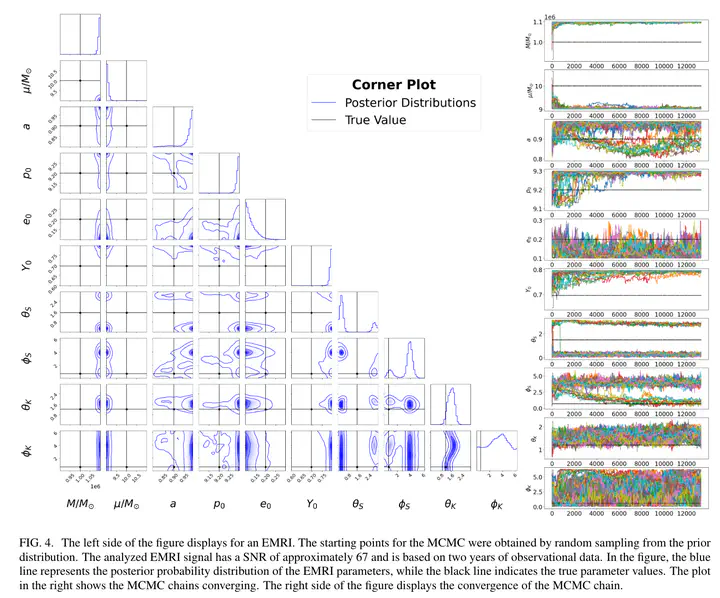
- CNF posteriors visually indistinguishable from MCMC
- Corner plots show excellent agreement
- All parameter correlations captured
- Multimodal structure preserved when present
Statistical Measures
- Mean and median parameters: differences <1σ
- Standard deviations: agreement within sampling uncertainty
- Credible intervals: consistent coverage
- Kullback-Leibler divergence: negligible
- Jensen-Shannon divergence: <0.01 for most parameters
Unbiased Estimation
- No systematic biases detected across parameter space
- Injection-recovery tests: true values within credible intervals
- Coverage tests: proper frequentist calibration
- Bias <0.1σ for all parameters
Computational Performance
Speed Improvements
- MCMC/Nested Sampling: Hours to days per event (depending on convergence)
- CNF Inference: Seconds per event (after training)
- Speed-up factor: 10⁴ to 10⁶ depending on parameter dimensionality
- Training time: Days (one-time cost, amortized over many events)
Scalability
- LISA expectation: ~1000 EMRIs over mission lifetime
- Traditional methods: Infeasible for full catalog with 17D analysis
- CNF approach: Enables comprehensive analysis of all detected EMRIs
- Population studies: Requires many individual analyses, now tractable
Parameter Recovery Accuracy
Well-Constrained Parameters
- Supermassive black hole mass M: <1% relative error
- Spin magnitude a: ~0.01-0.05 absolute error
- Sky location: degree-level precision for high SNR
- Inclination: well-determined from amplitude modulation
Moderately Constrained
- Small object mass m: ~10% relative error
- Eccentricity: dependent on orbital phase coverage
- Distance: ~20-50% uncertainty typical
- Spin orientation angles: moderate constraints
Challenging Parameters
- Argument of periapsis ω: degeneracies for low eccentricity
- Initial phase Φ₀: weaker constraints
- Polarization angle ψ: correlations with other angles
- Coalescence time: well-determined but covariant with phase
SNR Dependence
- High SNR (>30): Excellent parameter recovery
- Moderate SNR (15-30): Robust performance
- Low SNR (<15): Increased uncertainties but unbiased
- Below SNR~10: Challenging, requires careful analysis
Robustness Tests
Parameter Space Coverage
- Tested across full 17D space
- Mass ratios: 10⁻⁴ to 10⁻⁶
- Various eccentricities: quasi-circular to eccentric
- Different spins: non-spinning to near-extremal
- All sky locations and orientations
Waveform Systematics
- Robustness to waveform model uncertainties
- Training on approximate models, testing on higher-fidelity
- Graceful degradation rather than catastrophic failure
Noise Realizations
- Different noise instantiations
- Time-varying noise characteristics
- Galactic confusion noise levels
Impact
For LISA Science
Mission-Enabling Capability
- Makes comprehensive EMRI catalog analysis computationally feasible
- Enables science goals requiring many parameter estimation runs
- Supports population studies and astrophysical inference
- Critical for maximizing scientific return
EMRI Science Applications
- Black hole spin measurements
- Strong-field GR tests
- Mapping Kerr spacetime geometry
- Galactic nuclei stellar dynamics
- Massive black hole demographics
Data Analysis Pipelines
- Integration into LISA analysis software
- Rapid preliminary parameter estimation
- Refinement with traditional methods for selected events
- Support for various EMRI subtypes
For Machine Learning in Gravitational Waves
Methodological Milestone
- First ML application to most complex GW source type
- Validates scalability to high-dimensional problems
- Demonstrates viability for mission-critical science
- Establishes benchmark for future methods
Flow Matching Demonstration
- Flow matching technique shown effective for astrophysical inference
- Alternative to traditional normalizing flows
- Improved training stability in high dimensions
- Applicable to other complex inference problems
For Bayesian Inference
Simulation-Based Inference
- Practical validation in extremely challenging regime
- Amortized inference benefits demonstrated
- Complementary to traditional sampling methods
- Hybrid approaches possible (CNF proposals for MCMC)
High-Dimensional Inference
- Proof-of-concept for 17D problems
- Strategies for even higher dimensions
- Feature learning critical for scalability
- Opens doors to more ambitious modeling
Resources
Publication
- arXiv Preprint: arXiv:2409.07957 [astro-ph, physics:physics]
Authors
- Bo Liang (Lead author)
- Hong Guo, Tianyu Zhao, He Wang, Herik Evangelinelis
- Yuxiang Xu, Chang Liu, Manjia Liang, Xiaotong Wei
- Yong Yuan, Peng Xu, Minghui Du
- Wei-Liang Qian, Ziren Luo
EMRI Background
Astrophysical Context
- Formation mechanisms: Two-body relaxation, Hills capture
- Event rates: ~10-1000 per year for LISA
- Host galaxies: Centers of massive galaxies
- Companion objects: Main-sequence stars, white dwarfs, neutron stars, stellar black holes
LISA EMRI Science
- Primary science goal for LISA mission
- “Golden binaries”: High SNR, well-measured spins
- Strong-field gravity regime tests
- Supermassive black hole census
Waveform Modeling Challenges
- Self-force calculations: Radiation reaction in extreme mass ratio
- Gravitational self-force community efforts
- Transition from adiabatic to plunge
- Spin-induced precession
Related Work
Traditional EMRI Analysis
- MCMC: Markov chain Monte Carlo methods
- Nested sampling: MultiNest, PolyChord
- Genetic algorithms
- Parallel tempering
Machine Learning for GWs
- Parameter estimation for compact binaries (ground-based)
- Normalizing flows for MBHB analysis
- Neural posterior estimation
- Transfer learning approaches
Flow Matching
- Recent advances in generative modeling
- Applications in computer vision and NLP
- Physics-informed flow matching
- Optimal transport theory connections
Software and Tools
EMRI Waveform Tools
- FastEMRIWaveforms: GPU-accelerated waveform generation
- EMRI Kludge Suite: Approximate waveforms
- Black Hole Perturbation Toolkit
- Numerical relativity catalogs
Machine Learning Frameworks
- PyTorch/JAX for neural ODEs
- torchdiffeq: ODE solvers for PyTorch
- Flow matching libraries
- Normalizing flow packages (nflows, glasflow)
LISA Analysis Software
- LISA Analysis Tools (LDC)
- LISA Data Challenge infrastructure
- LISA Instrument and LPF
- Mock data generators
Future Directions
Methodological Improvements
- Higher-fidelity waveform models
- Uncertainty quantification for neural network predictions
- Active learning for efficient training data selection
- Hybrid methods: CNF + MCMC for refinement
Extended Physics
- Precessing EMRI systems
- Eccentric orbits with higher fidelity
- Environmental effects (accretion, dynamical friction)
- Beyond-GR modifications
Additional Applications
- Galactic binaries (verification sources)
- Intermediate mass ratio inspirals (IMRIs)
- Multi-source global fits
- Joint analysis with MBHBs
Operational Deployment
- Real-time parameter estimation during mission
- Alert generation for electromagnetic follow-up
- Automated quality control
- Integration with official LISA pipelines
Population Inference
- Hierarchical Bayesian analysis of EMRI populations
- Spin distribution of supermassive black holes
- Host galaxy correlations
- Selection effects and detection biases