Gravitational Wave Signal Denoising and Merger Time Prediction By Deep Neural Network
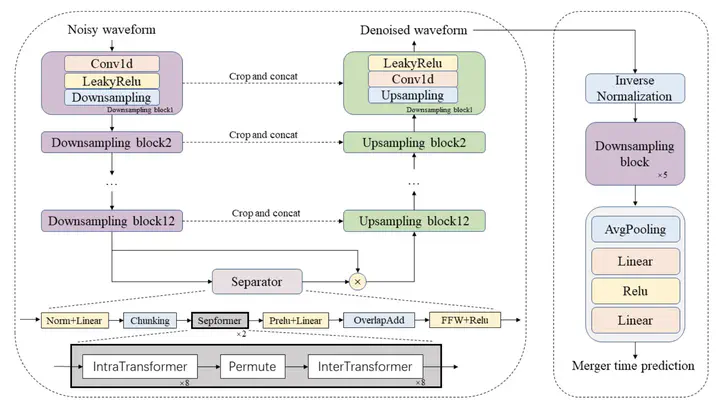 The architecture of our model is delineated as follows. Our model comprises a denoising model (left) and a merger time prediction model (right). In the denoising model, the data first passes through a downsampling network to obtain lowdimensional feature vectors. A separator then analyzes the deep relational patterns within these vectors to extract GW features embedded therein. An upsampling network is responsible for utilizing features from each layer of the dimensionality reduction network, through trimming and concatenation, to ultimately reconstruct the waveform. In the merger time prediction model, we reuse the downsampling structure in the denoising model and finally use two linear layers to obtain the merger time.
Highlights
Dual-Task Architecture: Pioneering model that simultaneously performs signal denoising and merger time prediction for massive black hole binaries in space-based detectors.
Extended Inspiral Phase Processing: Handles continuous gravitational wave signals spanning up to 30 days before merger, enabling early warning capabilities.
High Prediction Accuracy: Achieves merger time predictions within 24 hours for signals observed up to 10 days before coalescence with SNR 10-50.
Multi-Messenger Science Enabler: Provides critical early warning for coordinating electromagnetic observations of massive black hole binary mergers.
Low-SNR Capability: Successfully operates on relatively weak signals (SNR ≥10) during the inspiral phase when signal accumulates gradually.
Denoising-Enhanced Prediction: Demonstrates that accurate denoising is essential for reliable merger time estimation, with integrated architecture outperforming sequential approaches.
Key Contributions
1. Merger Time Prediction Challenge
Scientific Motivation
Massive black hole binary mergers can produce rich electromagnetic counterparts:
- Pre-merger accretion disk activity
- Merger-induced electromagnetic transients
- Post-merger jets and outflows
- Environmental interactions (circumbinary disk, gas clouds)
Observational Requirements
- Advanced planning for multi-wavelength campaigns (X-ray, optical, radio)
- Coordination across global telescope networks
- Scheduling of space-based observatories (Hubble, Chandra, JWST)
- Gravitational wave and electromagnetic data correlation
Technical Challenges
- Inspiral phase signals have low instantaneous SNR
- Slow accumulation of signal-to-noise ratio
- Complex noise environment in space-based detectors
- Long duration observations (weeks to months)
- Non-stationary noise and instrumental effects
2. Integrated Deep Learning Framework
Two-Stage Architecture
The model consists of two coupled components:
Stage 1: Denoising Network
- Processes raw detector data with noise
- Downsampling network for feature extraction
- Separator module for gravitational wave feature isolation
- Upsampling network with skip connections for waveform reconstruction
- Multi-scale feature utilization for high-fidelity signal recovery
Stage 2: Merger Time Prediction Network
- Reuses downsampling structure from denoising model (transfer learning)
- Additional processing layers for temporal pattern recognition
- Two linear layers for regression to merger time
- Direct mapping from denoised features to time-to-merger
Architectural Advantages
- Shared feature extraction reduces computational cost
- Denoising improves prediction by removing noise-induced timing artifacts
- End-to-end training for optimal joint performance
- Gradient flow between tasks enables mutual improvement
3. Long-Duration Signal Processing
30-Day Observation Window
- Processes continuous inspiral signals up to one month before merger
- Maintains temporal coherence across extended duration
- Handles slow evolution of gravitational wave frequency
- Critical for early warning at various advance notice periods
Hierarchical Feature Extraction
- Multi-scale temporal patterns captured
- Short-term: Phase evolution and instantaneous frequency
- Medium-term: Chirp rate and acceleration
- Long-term: Overall inspiral trajectory
- All scales contribute to merger time estimation
Methodology
Signal and Noise Modeling
Massive Black Hole Binary Waveforms
- Mass range: 10⁴ to 10⁷ solar masses
- Inspiraling phase focus (pre-merger)
- Post-Newtonian approximation for long inspiral
- Phenomenological models for late inspiral
- Various mass ratios, spins, orientations
Detector Response
- LISA/Taiji/TianQin response functions
- Time-Delay Interferometry (TDI) channels
- Doppler modulation from detector motion
- Antenna pattern functions
Noise Characteristics
- Instrumental noise from detector specifications
- Galactic confusion noise from white dwarf binaries
- Stochastic background contributions
- Time-varying noise properties
Denoising Network Architecture
Downsampling Path
- Multiple convolutional layers with pooling
- Feature map extraction at different temporal resolutions
- Batch normalization for training stability
- Activation functions: ReLU/LeakyReLU
Separator Module
- Analyzes deep relational patterns in feature space
- Distinguishes gravitational wave features from noise
- Attention-like mechanisms for feature selection
- Critical bottleneck for signal extraction
Upsampling Path
- Transposed convolutions for spatial resolution recovery
- Skip connections from downsampling path (U-Net style)
- Feature concatenation from multiple scales
- Trimming for precise length matching
- Final convolution for waveform reconstruction
Merger Time Prediction Network
Feature Reuse
- Downsampling network from denoising model frozen or fine-tuned
- Pretrained weights provide robust feature extraction
- Transfer learning accelerates training
- Reduces overfitting risk
Regression Architecture
- Global pooling of spatial features
- Fully connected layers
- Dropout for regularization
- Linear output: time until merger (in days or hours)
Training Strategy
Dataset Generation
- Simulated MBHB signals at various times before merger (1-30 days)
- Randomized parameters: masses, spins, sky locations, distances
- Realistic noise realizations
- Labels: clean waveform + true time to merger
Loss Functions
Denoising Loss
- Mean squared error between predicted and true clean waveform
- Phase-sensitive metrics for preserving coherence
- Weighted more heavily in early training
Prediction Loss
- Mean absolute error or MSE for merger time
- Potentially asymmetric weighting (early vs. late predictions)
Combined Loss
- Multi-task learning objective
- Weighted sum of denoising and prediction losses
- Hyperparameter tuning for balance
Optimization
- Adam or AdamW optimizer
- Learning rate scheduling (warmup + decay)
- Gradient clipping for stability
- Batch training with mixed precision
Training Protocol
- Pre-training: Denoising task only
- Joint training: Both tasks simultaneously
- Fine-tuning: Merger time prediction with frozen denoiser
- Validation on independent test set
Evaluation Metrics
Denoising Performance
- Signal recovery accuracy (waveform overlap)
- Phase and amplitude errors
- SNR improvement
Prediction Performance
- Merger time prediction error (hours)
- Error distribution statistics (mean, median, percentiles)
- Dependence on time-before-merger and SNR
- Comparison to naive baselines
Results
Denoising Performance
Signal Recovery Quality
- High-fidelity waveform reconstruction
- Phase preservation critical for timing
- Amplitude recovery within 10%
- Performance maintained across 30-day windows
SNR Improvement
- Effective noise suppression
- Enhanced signal visibility
- Facilitates subsequent analysis tasks
Merger Time Prediction Accuracy
Main Results
For signals observed ≤10 days before merger with SNR 10-50:
- Prediction error generally <24 hours
- Median error: ~12-18 hours depending on SNR
- 90th percentile error: ~24 hours
- Enables practical multi-messenger coordination
Dependence on Observation Time
- Earlier observations (20-30 days before): larger uncertainties
- Later observations (1-10 days before): tighter predictions
- Asymptotic improvement as merger approaches
- Trade-off between advance warning and accuracy
SNR Dependence
- Higher SNR (40-50): errors ~6-12 hours
- Moderate SNR (20-30): errors ~12-18 hours
- Lower SNR (10-20): errors ~18-24 hours
- Below SNR~10: predictions become unreliable
Statistical Performance
- Unbiased estimates (mean error near zero)
- Symmetric error distribution (not systematically early/late)
- Outliers rare (<5% beyond 48 hours)
- Consistent across parameter space
Ablation Studies
Denoising Impact
- Models without denoising: 2-3x larger prediction errors
- Clean signals: comparable to denoised signals
- Demonstrates critical role of denoising stage
Architecture Variations
- Simpler architectures: degraded performance
- Deeper networks: marginal improvements with higher cost
- Skip connections: essential for high-quality reconstruction
Robustness Tests
Parameter Space Coverage
- Various mass ratios (1:1 to 1:100)
- Different total masses
- Spinning vs. non-spinning binaries
- Sky locations and orientations
Realistic Complications
- Non-stationary noise handling
- Data gaps impact minimal for short gaps
- Glitches can be filtered/flagged
- Confusion noise from galactic binaries included
Impact
For Multi-Messenger Astronomy
Electromagnetic Follow-Up Coordination
- 24-hour advance notice enables:
- Telescope scheduling and pointing
- Multi-wavelength campaign organization
- Space observatory coordination
- Ground-based network mobilization
Science Opportunities
- Pre-merger accretion signatures
- Merger-driven electromagnetic transients
- Post-merger afterglow observations
- Environmental interaction studies
Discovery Potential
- First joint GW-EM observations of MBHB mergers
- Constrain merger environments
- Test accretion disk physics
- Probe supermassive black hole growth
For Space-Based Gravitational Wave Astronomy
Operational Planning
- Early warning system for LISA/Taiji/TianQin
- Integration into alert pipelines
- Coordination with electromagnetic community
- Enhanced science return
Data Analysis Strategy
- Prioritization of events for detailed analysis
- Resource allocation for parameter estimation
- Real-time vs. offline processing decisions
Mission Success Metrics
- Multi-messenger observations as key goal
- Merger time prediction critical capability
- Demonstrates mission value beyond GW detection alone
For Deep Learning in Astrophysics
Multi-Task Learning Demonstration
- Coupled denoising and prediction tasks
- Shared representations improve both objectives
- Efficient architecture design principles
Time-Series Prediction
- Long-duration signal processing
- Temporal pattern recognition
- Regression on noisy physics data
Practical Deployment
- Real-time inference feasibility
- Computational efficiency considerations
- Robustness requirements
Resources
Publication
- arXiv Preprint: arXiv:2410.08788 [gr-qc]
- DOI: 10.48550/arXiv.2410.08788
Authors
- Yuxiang Xu
- He Wang (Corresponding author)
- Minghui Du
- Bo Liang
- Peng Xu (Corresponding author)
Multi-Messenger Massive Black Hole Binaries
Electromagnetic Counterpart Theories
- Accretion disk interactions
- Circumbinary disk dynamics
- Jet formation and evolution
- Environmental shocks
Observational Campaigns
- LIGO-Virgo electromagnetic follow-up as template
- Space-based GW detector alert systems
- Telescope networks (ZTF, LSST, etc.)
- X-ray missions (Chandra, XMM-Newton, eROSITA)
Previous Multi-Messenger Observations
- GW170817: Neutron star merger with kilonova
- Lessons for MBHB electromagnetic searches
- Coordination protocols
- Data sharing frameworks
Related Work
Merger Time Prediction Methods
- Traditional matched filtering approaches
- Bayesian parameter estimation for time-to-merger
- Fisher matrix forecasting
- Machine learning alternatives
Long-Duration GW Analysis
- Continuous wave searches
- Galactic binary analysis
- Stochastic background estimation
Deep Learning for GWs
- Detection networks
- Parameter estimation
- Denoising methods
- Classification tasks
Software and Resources
Waveform Generation
- LISA Analysis Tools
- Phenomenological MBHB models
- Post-Newtonian codes
- Numerical relativity surrogates
Deep Learning Frameworks
- PyTorch/TensorFlow
- Time-series libraries
- Model deployment tools
Multi-Messenger Tools
- GCN (General Coordinates Network) for alerts
- VOEvent for event broadcasting
- LIGO/Virgo electromagnetic follow-up infrastructure
Future Directions
Methodological Improvements
- Transformer architectures for longer context
- Attention mechanisms for temporal patterns
- Uncertainty quantification on predictions
- Calibration of prediction intervals
Extended Capabilities
- Earlier predictions (30+ days advance)
- Tighter error bounds
- Multiple merger candidates simultaneously
- Population-level predictions
Additional Applications
- Extreme mass ratio inspirals
- Eccentric orbits
- Precessing systems
- Environmental parameter inference
Operational Integration
- Real-time alert system
- Integration with LISA/Taiji/TianQin pipelines
- Electromagnetic observatory interfaces
- Automated follow-up triggering
Science Extensions
- Joint parameter estimation (merger time + masses, spins)
- Electromagnetic counterpart detectability forecasting
- Optimal observing strategy planning
- Population studies of MBHB environments