Challenges in space-based gravitational wave data analysis and applications of artificial intelligence
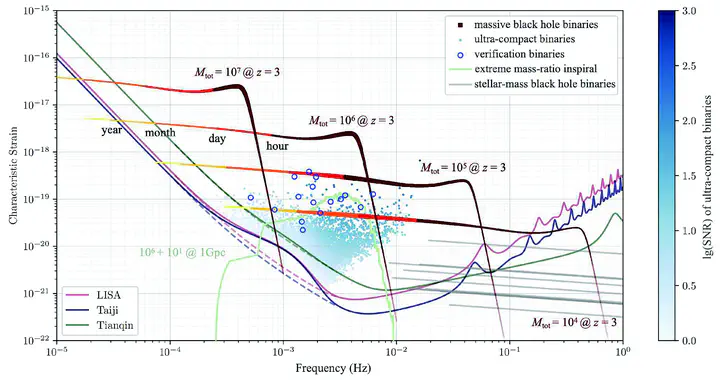 (Color online) The design sensitivity curves and primary target sources of the space-based gravitational wave detectors LISA, Taiji, and TianQin. The sensitivity of each detector is the total sensitivity of the first-generation Michelson-AET channel under the equal-arm-length approximation, expressed in terms of characteristic strain. The dashed curves represent the sensitivities resulting from instrumental noise (according to the noise requirements of LISA [11], Taiji [18], and TianQin [21]), while the solid curves represent the results after incorporating the galactic foreground noise.
Overview
This comprehensive review article provides a systematic examination of the unprecedented data analysis challenges facing space-based gravitational wave detection missions (LISA, Taiji, TianQin) and presents the transformative role artificial intelligence is playing in addressing these challenges. As the first major Chinese-language review on this topic, it serves as both a tutorial for newcomers and a comprehensive reference for researchers in the field.
Context and Motivation
The Dawn of Space-Based Gravitational Wave Astronomy
Following the spectacular success of ground-based detectors (LIGO, Virgo, KAGRA), the next frontier is space:
Three Major Space Missions:
- LISA (Laser Interferometer Space Antenna): ESA-NASA collaboration, launch ~mid-2030s
- Taiji: Chinese mission, similar timeline to LISA
- TianQin: Chinese mission focusing on lower frequencies
Scientific Targets:
- Massive black hole binaries (MBHBs): $10^4-10^7 M_\odot$
- Extreme mass ratio inspirals (EMRIs): stellar objects orbiting massive black holes
- Galactic compact binaries: millions of white dwarf binaries in our galaxy
- Stochastic gravitational wave background
- Unexpected sources and phenomena
Unprecedented Data Analysis Challenges
Space-based detection faces unique difficulties:
Signal Complexity:
- Thousands of overlapping sources simultaneously
- Signals lasting weeks to months
- Parameter spaces with 10-20 dimensions per source
- Non-stationary instrumental characteristics
Computational Demands:
- Global fitting of all sources together
- Bayesian inference in ultra-high dimensions
- Years of continuous data streams
- Real-time analysis requirements for alerts
Data Quality Issues:
- Instrumental glitches and artifacts
- Data gaps from various causes
- Time-varying noise characteristics
- Multiple data channels to combine
These challenges far exceed anything encountered in ground-based detection, necessitating fundamentally new approaches—where AI offers transformative solutions.
Scope and Structure
Comprehensive Coverage
The review systematically addresses:
Theoretical Foundations:
- Bayesian statistical inference framework
- Signal models and waveform templates
- Detector response and data characteristics
- Noise modeling and subtraction
Data Analysis Methodology:
- Likelihood function construction
- Sampling algorithms (MCMC, nested sampling, etc.)
- Global fitting strategies
- Computational optimization techniques
AI Applications:
- Machine learning for waveform modeling
- Neural networks for signal detection
- Deep learning for parameter estimation
- AI-driven noise characterization
- Automated anomaly detection
Target Audience
Written for:
- Graduate students entering the field
- Researchers transitioning from ground-based to space-based
- AI/ML scientists interested in gravitational wave applications
- Theoretical physicists seeking observational context
- Mission planners and data pipeline designers
Key Themes and Contributions
1. Bayesian Framework as Organizing Principle
The review uses Bayesian inference as the conceptual thread:
Fundamental Elements:
- Prior: Astrophysical population models and parameter bounds
- Likelihood: Relation between parameters and observed data
- Posterior: Inferred parameter distributions given observations
- Evidence: Model comparison and selection
Computational Challenges:
- High-dimensional parameter spaces
- Multimodal posteriors from parameter degeneracies
- Expensive likelihood evaluations
- Evidence computation for model selection
AI Connections:
- Neural networks for fast likelihood approximation
- Normalizing flows for posterior sampling
- Machine learning for proposal distributions
- Amortized inference across source populations
2. Waveform Modeling Landscape
Comprehensive treatment of gravitational wave signal models:
Theoretical Approaches:
- Numerical Relativity: Full Einstein equations solved numerically
- Post-Newtonian: Perturbative expansion in orbital velocity
- Effective-One-Body: Resummation of PN series with NR calibration
- Phenomenological: Data-driven interpolation models
AI-Enhanced Modeling:
- Neural networks learning waveforms from NR simulations
- Gaussian processes interpolating in parameter space
- Surrogate models for fast evaluation
- Reduced-order modeling with ML compression
Trade-offs:
- Accuracy vs. computational cost
- Physical fidelity vs. speed
- Domain of validity vs. generality
3. Detector Response and Data Model
Detailed discussion of space-based detector characteristics:
LISA/Taiji/TianQin Configurations:
- Triangular constellation of three spacecraft
- Millions of kilometers arm lengths
- Laser interferometry between spacecraft
- Multiple data channels (A, E, T combinations)
Response Function:
- Time-dependent due to orbital motion
- Sky-location and polarization dependence
- Doppler modulation
- Antenna pattern functions
Noise Sources:
- Instrumental Noise: Laser frequency fluctuations, proof mass acceleration noise
- Confusion Noise: Unresolved galactic binaries forming stochastic foreground
- Glitches: Transient artifacts
- Gaps: Data downlink, instrumental issues
Data Combination Strategies:
- Time-delay interferometry (TDI) to cancel laser noise
- Optimal data channel combinations
- Multi-channel analysis benefits
4. Likelihood Function Construction
Central challenge in Bayesian inference:
Standard Form: $$\mathcal{L}(\theta | d) \propto \exp\left(-\frac{1}{2}\langle d - h(\theta) | d - h(\theta) \rangle\right)$$
Where:
- $d$: observed data
- $h(\theta)$: signal template with parameters $\theta$
- $\langle \cdot | \cdot \rangle$: noise-weighted inner product
Complications in Space-Based Case:
- Overlapping signals: $d = \sum_i h_i(\theta_i) + n$
- Non-Gaussian noise from glitches
- Time-varying noise PSD
- Computationally expensive template generation
AI Solutions:
- Fast neural surrogate likelihoods
- Learned noise characteristics
- Implicit likelihood inference
- Simulation-based inference techniques
5. Sampling Strategies
Survey of algorithms for exploring posterior distributions:
Markov Chain Monte Carlo (MCMC):
- Metropolis-Hastings algorithm
- Hamiltonian Monte Carlo for gradient utilization
- Parallel tempering for multimodality
- Adaptive proposals
Nested Sampling:
- Evidence computation alongside parameter estimation
- Efficient for multimodal posteriors
- Dynamic nested sampling variants
- Parallelization challenges
Modern Innovations:
- Normalizing Flows: Learned bijective transformations for efficient sampling
- Variational Inference: Optimization-based approximate posterior
- Neural Posterior Estimation: Direct neural network posterior approximation
- Simulation-Based Inference: Bypasses explicit likelihood evaluation
AI Enhancements:
- Learned proposal distributions
- Neural network surrogate models for fast evaluation
- Adaptive sampling guided by ML
- Amortized inference across many events
6. Global Fitting Problem
Unique to space-based detection:
Challenge:
- Thousands of sources overlap in data
- Must fit all simultaneously
- Parameter correlations across sources
- Combinatorial explosion of possibilities
Strategies:
- Reversible-jump MCMC for varying number of sources
- Trans-dimensional sampling
- Hierarchical modeling
- Iterative source subtraction
AI Approaches:
- Neural networks for source detection and counting
- Deep learning for source separation
- Reinforcement learning for search strategies
- Attention mechanisms for multi-source modeling
7. AI for Waveform Modeling
Detailed examination of ML approaches to signal generation:
Generative Models:
- Variational Autoencoders (VAEs) for waveform compression
- Generative Adversarial Networks (GANs) for sample generation
- Conditional normalizing flows for parameter-to-waveform mapping
Surrogate Modeling:
- Neural networks approximating expensive waveforms
- Gaussian processes for uncertainty quantification
- Reduced-basis methods with ML-selected bases
- Multi-fidelity modeling
Benefits:
- Orders-of-magnitude speedup in likelihood evaluation
- Enable otherwise infeasible analyses
- Continuous coverage of parameter space
- Uncertainty quantification
Challenges:
- Validation against ground truth
- Accuracy requirements for scientific inference
- Generalization beyond training domain
- Systematic error control
8. AI for Noise and Data Quality
Machine learning transforming data preprocessing:
Noise Characterization:
- Non-stationary noise PSD estimation
- Anomaly detection in noise properties
- Glitch classification and removal
- Data gap handling
Glitch Mitigation:
- Supervised learning for glitch identification
- Unsupervised clustering of glitch types
- Inpainting missing data
- Robust statistics for contaminated data
Quality Assessment:
- Automated data validation
- Real-time monitoring
- Predictive maintenance for instruments
- Confidence estimation for segments
9. AI for Signal Detection
Deep learning revolutionizing search pipelines:
Detection Architectures:
- Convolutional neural networks for time series
- Recurrent networks for temporal sequences
- Attention mechanisms for long-range dependencies
- Multi-scale architectures
Advantages:
- Real-time or faster-than-real-time processing
- Template-free detection of unexpected signals
- Handling of overlapping sources
- Automatic feature learning
Applications:
- MBHB rapid detection for multi-messenger alerts
- EMRI identification in confusion noise
- Extreme event discovery
- Triggered searches around external events
10. AI for Parameter Estimation
Neural approaches to inference:
Direct Regression:
- End-to-end networks: data → parameters
- Fast point estimates
- Uncertainty quantification challenges
Posterior Estimation:
- Conditional normalizing flows: bijective mapping to simple distributions
- Mixture density networks: flexible posterior families
- Neural posterior estimation: simulation-based inference
- Bayesian neural networks: uncertainty in network itself
Advantages:
- Amortization: train once, infer many times instantly
- Avoids MCMC for each new event
- Natural parallelization
- Enables population studies
Considerations:
- Training data requirements
- Generalization to distribution tails
- Systematic errors
- Validation strategies
11. Novel AI Techniques Highlighted
Cutting-edge methods:
Normalizing Flows:
- Detailed technical exposition
- Applications to GW inference
- Recent architectures (coupling layers, neural spline flows)
- Integration with sampling algorithms
Simulation-Based Inference (SBI):
- Likelihood-free inference
- Neural density estimation
- Sequential neural posterior estimation
- Applications when likelihood intractable
Transfer Learning:
- Pre-training on simulations
- Fine-tuning on real data
- Domain adaptation
- Multi-task learning
Physics-Informed Neural Networks:
- Incorporating Einstein equations
- Waveform consistency constraints
- Conservation laws
- Improved extrapolation
Practical Guidance
Software Ecosystems
Review discusses key tools:
Waveform Generation:
LALSuite: LIGO Algorithm LibraryPhenomD/PhenomPv2: Phenomenological models- Various NR waveform catalogs
Inference Frameworks:
bilby: Bayesian inference libraryPyCBC: Search and parameter estimationLISACode/LISA Orbits: LISA-specific tools
AI Libraries:
PyTorch/TensorFlow: Deep learning frameworksnflows/normflows: Normalizing flow implementationssbi: Simulation-based inference toolkit- Custom domain-specific packages
Computational Resources
Infrastructure considerations:
Training Requirements:
- GPU clusters for neural network training
- Large-scale waveform simulation campaigns
- Data storage and management
- Parallelization strategies
Inference Deployment:
- Real-time processing constraints
- Cloud vs. HPC vs. on-premises
- Scalability to operational data rates
- Cost-benefit analyses
Critical Evaluation
AI Advantages
The review honestly assesses benefits:
- Speed: Orders of magnitude faster than traditional methods
- Flexibility: Learns from data, adapts to complexities
- Scalability: Handles high-dimensional problems
- Discovery: Potential for unexpected signal detection
AI Limitations
Also acknowledges challenges:
- Validation: Ensuring reliability for scientific inference
- Generalization: Performance on out-of-distribution data
- Interpretability: Understanding what networks learn
- Systematic Errors: Bias from training data or architecture
- Data Requirements: Need extensive simulations
Complementarity Perspective
Emphasizes synergy with traditional methods:
- Hybrid Pipelines: AI for screening, matched filtering for confirmation
- Mutual Validation: Cross-checks between approaches
- Specialized Roles: AI for detection speed, MCMC for posterior exploration
- Continual Improvement: Each method informs the other
Future Outlook
Near-Term (Before Launch)
Pre-mission developments:
- Refined AI architectures for data challenges
- Comprehensive validation studies
- End-to-end pipeline demonstrations
- Mission requirement refinement
Medium-Term (Early Operations)
Initial data analysis:
- Deployment of operational pipelines
- Refinement based on real data
- Rapid multi-messenger alerts
- First scientific discoveries
Long-Term Vision
Mature field:
- AI-human collaboration in discovery
- Automated science from GW data
- Integration across astronomy
- New paradigms from unexpected signals
Significance and Impact
For Chinese Gravitational Wave Community
Particularly important because:
- First Major Review: Comprehensive Chinese-language resource
- Supports Taiji/TianQin: Directly relevant to Chinese missions
- Educational Resource: Training next generation
- Research Roadmap: Guides future investigations
For International Community
Broader contributions:
- Comprehensive Synthesis: Pulls together scattered literature
- Bayesian Framework: Unified perspective on diverse methods
- AI Integration: How AI fits into established workflows
- Practical Guide: Actionable advice for practitioners
For AI in Science
Exemplifies:
- High-Stakes Application: Where reliability is paramount
- Domain Knowledge Integration: Physics-informed ML
- Validation Standards: Rigorous testing requirements
- Interdisciplinary Collaboration: Physicists and computer scientists
Related Work
The review connects to:
- Ground-based GW detection AI applications
- Astronomy big data challenges
- Bayesian inference methodology
- Scientific machine learning
Resources for Readers
The paper points to:
- Public datasets (LISA Data Challenges)
- Open-source software packages
- Educational materials and tutorials
- Active research collaborations
Conclusion
This comprehensive review establishes a foundation for understanding and advancing the critical role of artificial intelligence in space-based gravitational wave astronomy. By systematically covering challenges, methods, applications, and future directions within a coherent Bayesian framework, it serves as both an essential introduction for newcomers and a valuable reference for active researchers.
The work demonstrates that AI is not merely a convenience but a necessity for realizing the full scientific potential of missions like LISA, Taiji, and TianQin. As these missions approach launch, the synergy between advanced statistical methods, high-performance computing, and artificial intelligence will be essential for transforming raw data into profound insights about the universe.
For the gravitational wave community, this review charts a course through the complex landscape of data analysis challenges toward the exciting discoveries that await in the coming era of space-based gravitational wave astronomy.