Automated Algorithmic Discovery for Scientific Computing through LLM-Guided Evolutionary Search: A Case Study in Gravitational-Wave Detection
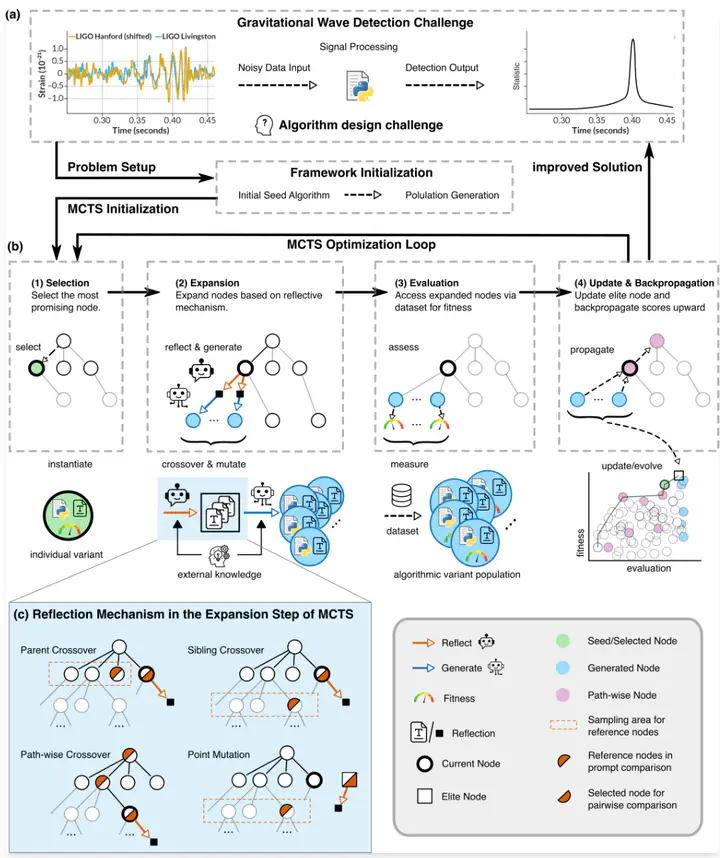 Illustration of the LLM-Informed Evo-MCTS framework for automated algorithm discovery in gravitational-wave detection.
Highlights
Breakthrough in Automated Algorithm Discovery: Evo-MCTS represents a paradigm shift in scientific computing by enabling automated discovery of interpretable algorithms that match or exceed human-designed solutions.
Exceptional Performance Gains: Achieves 20.2% improvement over domain-specific methods and 59.1% improvement over LLM-based optimization frameworks in gravitational wave detection tasks.
Interpretability-First Design: Unlike black-box optimization approaches, Evo-MCTS produces transparent, scientifically validatable algorithmic structures that domain experts can understand, verify, and trust.
Domain-Agnostic Framework: The architecture is designed for generalizability across scientific computing domains, not limited to gravitational wave physics.
Integration of LLM and Evolutionary Search: Successfully combines the domain knowledge of large language models with the systematic exploration capabilities of Monte Carlo Tree Search.
Handles Complex Constraints: Effectively manages vast design spaces with expensive evaluations while respecting domain-specific physical constraints requiring expert knowledge.
Key Contributions
1. Novel Framework Architecture
The Evo-MCTS framework introduces a three-pillar approach to automated algorithm discovery:
- Reflective Code Synthesis: Leverages LLM capabilities to generate physically-grounded candidate algorithms informed by domain knowledge
- Multi-Scale Evolutionary Operations: Applies structured mutations on code representations across different abstraction levels, enabling both fine-grained and architectural-level improvements
- Tree-Guided Exploration: Employs Monte Carlo Tree Search to navigate the algorithmic design space systematically, balancing exploration and exploitation
2. Interpretable Algorithm Discovery
Addresses the fundamental challenge in scientific computing where algorithmic transparency is as critical as performance. The framework produces solutions that:
- Integrate multiple functional components coherently
- Emerge from tree-guided exploration as interpretable pathways
- Enable scientists to validate and understand the underlying logic
- Support scientific reproducibility and trust
3. Rigorous Validation in Complex Domain
Demonstrates effectiveness in gravitational wave detection, a particularly challenging domain featuring:
- Continuous high-dimensional parameter spaces
- Strict physical constraints
- Expensive computational evaluations
- Need for domain expert validation
Methodology
Problem Formulation
Automated algorithm discovery in scientific computing faces three fundamental challenges:
- Vast Design Spaces: Exponential growth of possible algorithmic configurations with expensive evaluation costs
- Domain Constraints: Physical laws and domain-specific requirements that must be respected
- Interpretability Requirements: Solutions must be understandable and validatable by scientists
Evo-MCTS Architecture
The framework operates through iterative cycles:
Phase 1: Tree-Guided Exploration
- Monte Carlo Tree Search maintains a tree of algorithmic candidates
- Each node represents a code structure with associated performance metrics
- Selection balances between exploiting promising branches and exploring new regions
Phase 2: LLM-Informed Code Generation
- Large language models generate code variations informed by domain knowledge
- Reflective synthesis ensures physical validity and adherence to constraints
- Multiple scales of mutation enable both refinement and radical redesign
Phase 3: Evolutionary Operations
- Structured mutations on code abstract syntax trees
- Crossover operations between high-performing candidates
- Multi-scale modifications from token-level to block-level changes
Phase 4: Evaluation and Selection
- Candidate algorithms evaluated on realistic benchmark problems
- Performance metrics combined with interpretability scores
- Successful candidates inform future exploration
Key Technical Innovations
- Structured Code Representation: Algorithms represented as abstract syntax trees enabling meaningful mutations
- Domain Knowledge Integration: LLM provides physics-aware code generation rather than blind search
- Interpretable Pathways: Tree structure naturally provides explanation of algorithmic evolution
- Adaptive Exploration: MCTS automatically adjusts exploration strategy based on discovered patterns
Results
Gravitational Wave Detection Performance
The framework was evaluated on gravitational wave detection pipelines, comparing against:
- Domain-specific baseline methods (traditional matched filtering and coherent analysis)
- LLM-based optimization frameworks (pure prompt-based approaches)
Quantitative Improvements:
- 20.2% performance gain over carefully engineered domain-specific methods
- 59.1% performance gain over alternative LLM-based optimization approaches
- Consistent convergence toward high-quality solutions across multiple runs
Algorithm Interpretability
Discovered algorithms exhibit:
- Clear modular structure with identifiable functional components
- Integration of multiple signal processing techniques (filtering, coherent analysis, statistical tests)
- Transparent decision-making logic that domain experts can validate
- Novel combinations of known techniques that were not obvious a priori
Convergence Characteristics
- Efficient exploration of design space with fewer evaluations than baseline evolutionary approaches
- Stable convergence patterns demonstrating robustness
- Ability to escape local optima through LLM-guided exploration
Generalization Capabilities
Although demonstrated on gravitational waves, the domain-agnostic architecture suggests applicability to:
- Other physics simulations requiring custom algorithmic pipelines
- Scientific data analysis problems with complex constraints
- Optimization problems requiring interpretable solutions
Impact
For Gravitational Wave Astronomy
- Accelerated Method Development: Reduces the human time required to design new analysis algorithms from months to days
- Novel Algorithm Discovery: Found effective combinations of techniques not previously considered by domain experts
- Democratization: Makes advanced algorithm design accessible to researchers without deep algorithmic expertise
For Scientific Computing Broadly
- New Paradigm: Establishes automated algorithm discovery as a viable approach for scientific problems
- Interpretability Standards: Demonstrates that performance and transparency need not be competing objectives
- Methodological Framework: Provides a reusable architecture applicable across scientific domains
For AI and Optimization
- LLM Integration: Shows effective ways to incorporate language model capabilities in optimization frameworks
- Hybrid Approaches: Validates combining symbolic methods (tree search) with neural approaches (LLMs)
- Practical Validation: Demonstrates real-world impact beyond benchmark problems
Resources
Code and Implementation
- GitHub Repository: https://github.com/iphysresearch/evo-mcts - Full implementation with examples and documentation
- Project Website: https://iphysresearch.github.io/evo-mcts/ - Comprehensive project documentation, tutorials, and results
Publication and Presentation
- arXiv Paper: arXiv:2508.03661 [cs.AI] - Full technical paper with detailed methodology and experiments
- Presentation Slides: Nature Conference Talk (October 2025) - Overview presentation with key results
Related Work
- LIGO Scientific Collaboration: https://www.ligo.org - Context for gravitational wave detection
- Monte Carlo Tree Search: Classic AI planning method adapted for algorithmic search
- Large Language Models for Code: Building on recent advances in LLM code generation capabilities
Future Directions
The Evo-MCTS framework opens several promising research directions:
- Extension to other scientific computing domains (climate modeling, molecular dynamics, computational chemistry)
- Integration with formal verification tools for stronger correctness guarantees
- Multi-objective optimization balancing performance, interpretability, and computational cost
- Interactive mode allowing human experts to guide the search process
- Automated hyperparameter tuning within discovered algorithms