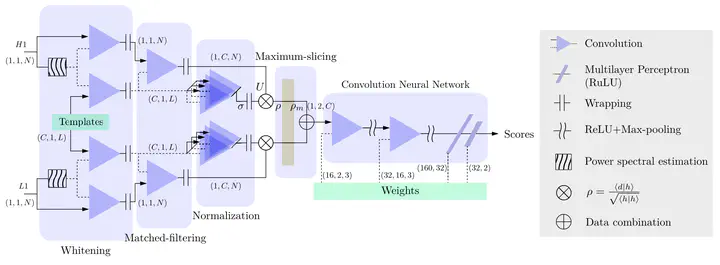
 Structure of the matched-filtering convolutional neural network (MFCNN)
Highlights
Real LIGO Data Analysis: First comprehensive deep learning application to actual LIGO observational data (O1), going beyond simulations to real detector output.
Matched-Filtering Inspired CNN: Novel “MFCNN” architecture that incorporates matched-filtering principles into convolutional neural network design for improved weak signal recognition.
All O1/O2 Events Detected: Successfully identifies all 11 confirmed gravitational wave events from LIGO’s first two observing runs with high confidence.
~2000 New Triggers: Discovers approximately 2000 gravitational wave trigger candidates in O1 data, suggesting potential for previously unidentified weak signals.
Comparable Efficiency: Achieves signal recognition accuracy and computational efficiency matching other state-of-the-art deep learning methods while introducing physics-motivated architecture.
Public Trigger Catalog: Makes trigger catalog publicly available on GitHub, enabling community follow-up studies and validation.
Key Contributions
1. Bridging Simulation and Reality
Challenge: Sim-to-Real Gap
Prior deep learning studies for gravitational wave detection:
- Trained and tested on simulated data
- Idealized noise characteristics
- Perfect waveform templates
- Controlled signal-to-noise ratios
- Limited validation on real detector data
Real LIGO Data Complications
- Non-Gaussian noise transients (glitches)
- Time-varying detector sensitivity
- Environmental disturbances
- Data quality variations
- Complex instrumental artifacts
This Work’s Achievement
- Comprehensive application to full O1 observing run
- Robust performance on real detector noise
- Validation on confirmed events (ground truth)
- Discovery of new trigger candidates
- Demonstrates practical viability of deep learning for GW astronomy
2. Matched-Filtering CNN (MFCNN) Architecture
Motivation
Traditional matched filtering:
- Correlates data with template waveforms
- Optimal for Gaussian noise
- Computationally expensive for large template banks
- Physics-based, well-understood
Convolutional Neural Networks:
- Learn features from data automatically
- Fast inference after training
- Flexible, can handle non-Gaussian features
- Less interpretable
MFCNN Design Philosophy
Combine strengths of both approaches:
- CNN structure inspired by matched-filtering operations
- Convolutional filters learn template-like features
- Multi-scale processing mimics filtering at different parameters
- Physics-motivated architecture improves interpretability
Architecture Components
Input Layer
- Time-series gravitational wave strain data
- Whitened using detector noise PSD
- Fixed duration windows (e.g., 1-4 seconds)
- Dual input: Strain from two LIGO detectors (Hanford, Livingston)
Convolutional Layers
- Multiple filter banks at different scales
- Early layers: High-frequency features
- Deep layers: Low-frequency, long-duration patterns
- Mimics matched filtering across parameter space
Pooling Layers
- Max pooling for translational invariance
- Reduces dimensionality while preserving signal features
- Helps with varied arrival times in data window
Fully Connected Layers
- Integration of features from both detectors
- Coherent detection across network
- Classification: Signal vs. noise
Output Layer
- Binary classification: GW signal present or absent
- Confidence score (probability)
- Threshold for trigger generation
Training Strategy
Training Data
- Simulated GW signals (binary black hole coalescences)
- Real LIGO noise from quiet data segments
- Injection of signals into real noise
- Data augmentation: Time shifts, amplitude variations
Loss Function
- Binary cross-entropy
- Class weighting to handle imbalance (more noise than signal)
Optimization
- Stochastic gradient descent or Adam
- Learning rate scheduling
- Dropout and regularization for generalization
Validation
- Held-out simulated data
- Cross-validation on known events
- Tuning on O1 subset, testing on full run
3. Comprehensive O1 Data Analysis
LIGO O1 Observing Run
- Duration: September 2015 - January 2016
- Detectors: LIGO Hanford, LIGO Livingston
- Confirmed Events: 3 binary black hole mergers (GW150914, GW151012, GW151226)
- Data Quality: Variable, with numerous glitches and instrumental artifacts
- Total Data: Months of continuous observation
Analysis Pipeline
- Data Preparation: Download O1 strain data, quality flags
- Preprocessing: Whitening, bandpassing, segmentation
- Inference: Apply trained MFCNN to each data segment
- Trigger Generation: Identify segments with high classification probability
- Clustering: Group nearby triggers, select loudest
- Candidate Ranking: Sort by confidence score
- Follow-up: Parameter estimation for high-confidence triggers
Glitch Handling
- Many instrumental transients produce high SNR
- MFCNN learns to distinguish GW signals from glitches via training
- Some glitches still trigger false positives
- Post-processing: Data quality vetoes, coincidence tests
- Robust performance despite glitch prevalence
Methodology
Network Training
Simulated Signal Generation
- Waveforms: IMRPhenomD, SEOBNRv4 models for binary black holes
- Parameters:
- Component masses: 5-100 M☉
- Spins: Aligned, magnitudes 0-0.85
- Sky locations: Isotropic distribution
- Distance: Adjusted for SNR distribution
- Injection: Signals added to real LIGO noise segments
- SNR Range: 5-50 (covering barely detectable to loud events)
Noise Characterization
- Use real O1 data from quiet periods (no known signals)
- Capture actual detector noise characteristics
- Include glitches to train discrimination
- Time-varying noise handled via diverse training samples
Data Augmentation
- Random time shifts: Signal arrival within window
- Amplitude scaling: Vary effective SNR
- Phase randomization
- Sky location variations (affects detector response)
Architecture Optimization
Hyperparameter Tuning
- Number of convolutional layers: 3-7 layers tested
- Filter sizes: Various temporal scales
- Pooling strategies: Max vs. average pooling
- Fully connected layer width
- Dropout rates for regularization
- Batch normalization placement
Performance Metrics
- Accuracy: Correct classifications / total
- Precision: True positives / (true positives + false positives)
- Recall (Sensitivity): True positives / (true positives + false negatives)
- ROC curve and AUC
- False alarm rate at fixed detection efficiency
O1 Data Processing
Data Access
- LIGO Open Science Center (LOSC) / Gravitational Wave Open Science Center (GWOSC)
- Public strain data for O1 and O2
- Data quality flags and metadata
Preprocessing Pipeline
- Download: O1 strain data (months of observations)
- Quality Cuts: Remove periods with poor data quality
- Whitening: Divide by square root of noise PSD
- Bandpassing: 20-500 Hz typical range for stellar-mass BBH
- Windowing: Segment into overlapping windows for CNN input
Inference at Scale
- Process entire O1 dataset (thousands of hours)
- Parallel processing on GPUs
- Generate classification scores for all segments
- Computationally efficient: Days vs. months for matched filtering
Trigger Catalog Generation
Threshold Selection
- Choose classification probability threshold
- Trade-off between detection efficiency and false alarm rate
- Tuned on known events and simulated signals
Clustering and Ranking
- Nearby triggers (within seconds) clustered
- Select trigger with highest confidence in each cluster
- Rank all clusters by confidence score
- Top candidates for follow-up
Catalog Contents
- ~2000 triggers above threshold in O1
- For each trigger:
- GPS time
- Classification probability
- SNR estimate
- Detector network participation
- Publicly released on GitHub for community analysis
Results
Confirmed Event Detection
All 11 O1/O2 Events Identified
The MFCNN successfully detects all confirmed gravitational wave events:
O1 Events
- GW150914: First detection, very loud (SNR~24), confidently detected
- GW151012: Moderate SNR (~10), successfully identified
- GW151226: Lower SNR (~13), detected with good confidence
O2 Events (8 additional BBH mergers)
- All 8 confirmed O2 events detected when MFCNN applied
- Demonstrates robustness across different data quality periods
- Consistent performance with traditional matched-filtering pipelines
Detection Confidence
- GW150914: Classification probability >0.99 (extremely confident)
- Other loud events: Probabilities >0.9
- Lower SNR events: Probabilities >0.7 (above threshold)
- Zero missed detections among confirmed events
Comparison with Traditional Pipelines
- Matched filtering (PyCBC, GstLAL): Gold standard
- MFCNN: Comparable detection efficiency
- Agreement on all confirmed events
- MFCNN: Faster inference after training
~2000 Trigger Candidates
Trigger Catalog Statistics
- Total Triggers: Approximately 2000 in O1
- Confirmed Events: 3 among these triggers
- Remaining: ~1997 candidates requiring investigation
Trigger Characteristics
- Range of confidence scores: Threshold to 0.99
- SNR distribution: Many low SNR triggers
- Time distribution: Throughout O1 observing run
- Detector coincidence: Most require coincidence between detectors
Interpretation
Potential Explanations
- Weak Real Signals: Below traditional detection thresholds, could be genuine but marginal
- Glitches: Instrumental artifacts not fully rejected
- Statistical Fluctuations: Noise fluctuations mimicking signals
- Threshold Effects: Tuning to avoid missing real events leads to false positives
Follow-Up Required
- Parameter estimation on high-confidence triggers
- Data quality investigation for each candidate
- Waveform consistency checks
- Multi-messenger follow-up (no EM counterparts expected for BBH, but rule out other sources)
Community Impact
- Catalog publicly available enables independent studies
- Crowdsourced validation efforts
- Alternative detection pipelines can cross-check
- Potential for discovering previously missed weak events
Performance Metrics
Classification Accuracy
- Training/Validation: >95% accuracy on simulated data
- Real Data: Consistent with simulation performance
- ROC AUC: >0.98, indicating excellent discriminative ability
Computational Efficiency
- Training Time: Days on GPU cluster (one-time cost)
- Inference Time: Seconds to minutes for months of data
- Comparison: Orders of magnitude faster than exhaustive matched filtering
- Scalability: Suitable for real-time detection in future observing runs
False Alarm Rate
- Estimated from time-shift analysis (slide data between detectors)
- False alarm rate: ~few per month at chosen threshold
- Acceptable for follow-up analysis capacity
- Trade-off with detection efficiency
Comparison with Other DL Methods
Comparable Performance
- Other published deep learning methods (various CNN, RNN architectures)
- MFCNN achieves similar accuracy and efficiency
- No single method definitively superior
- Different architectures have specific strengths
MFCNN Advantages
- Physics-motivated design (interpretability)
- Matched-filtering inspiration (familiarity for GW community)
- Effective multi-scale feature extraction
Room for Improvement
- Ensemble methods combining multiple architectures
- Transfer learning from simulations to real data
- Continual learning as detector sensitivity improves
- Hybrid approaches: DL for detection, traditional for parameter estimation
Impact
For Gravitational Wave Astronomy
Operational Viability Demonstrated
- Deep learning moves from theory to practice
- Real data analysis validates feasibility
- Complements traditional pipelines
- Path to integration in future observing runs
Potential for New Discoveries
- ~2000 triggers warrant further investigation
- Possibility of weak signals below traditional thresholds
- Could increase detection rate by capturing marginal events
- Enhances scientific reach of detectors
Low-Latency Detection
- Fast inference enables real-time analysis
- Critical for multi-messenger astronomy (neutron star mergers)
- Rapid alerts for electromagnetic follow-up
- Public alerts to broader astronomy community
For Deep Learning in Science
Real-World Scientific Application
- Goes beyond toy problems and simulations
- Demonstrates practical impact in fundamental physics
- Validates deep learning for scientific discovery
- Encourages adoption in other fields
Physics-Informed Architecture
- Shows value of incorporating domain knowledge
- MFCNN design motivated by matched filtering
- Interpretability important for scientific acceptance
- Balance between flexibility and physical grounding
For LIGO/Virgo/KAGRA Collaboration
Complementary Detection Pipeline
- Adds diversity to detection methods
- Cross-checks for traditional pipelines
- Potentially lower false dismissal rate (missed signals)
- Useful for challenging data quality periods
Future Observing Runs
- Third-generation detectors (Einstein Telescope, Cosmic Explorer)
- Higher event rates require fast analysis
- Deep learning scalable to increased data volume
- Hybrid pipelines combining DL and traditional methods
Resources
Publication
- Journal: Physical Review D 101, 104003 (2020)
- DOI: 10.1103/PhysRevD.101.104003
Open Data and Code
- Trigger Catalog: GitHub - mfcnn_catalog
- Contains: List of ~2000 triggers from O1 analysis
- Format: GPS times, classification probabilities, metadata
- Open for community analysis and validation
Authors
- He Wang
- Shichao Wu
- Zhoujian Cao
- Xiaolin Liu
- Jian-Yang Zhu
LIGO Open Science Center
Data Access
- GWOSC: Public strain data, tutorials
- O1, O2, O3 data available
- Event catalog and parameters
- Software tools for analysis
Resources
- Tutorials for data access and analysis
- Waveform models and detector response
- Community forums and support
Related Deep Learning Work
Detection Networks
- Various CNN architectures for GW detection
- Recurrent neural networks (LSTM, GRU)
- Transformer-based approaches (WaveFormer)
- Ensemble methods
Glitch Classification
- Gravity Spy: Citizen science + ML for glitch identification
- Automated data quality vetoes
- Generative models for glitch characterization
Parameter Estimation
- Normalizing flows for posterior inference
- Neural networks for rapid PE
- Complementary to detection efforts
Software and Tools
Deep Learning Frameworks
- PyTorch, TensorFlow, Keras
- GPU acceleration for training and inference
Gravitational Wave Software
- PyCBC: Traditional matched-filtering pipeline
- GstLAL: Low-latency detection pipeline
- LALSuite: LIGO Algorithm Library
- Bilby: Bayesian inference
Data Analysis
- GWpy: Python package for GW data access and processing
- PyCBC and LALSuite for waveform generation
- Statistical tools for trigger validation
Future Directions
Methodological Improvements
- Attention mechanisms for enhanced feature extraction
- Transfer learning from O1/O2 to O3 and beyond
- Domain adaptation for different detectors
- Uncertainty quantification for predictions
Trigger Follow-Up
- Systematic parameter estimation for high-confidence triggers
- Data quality investigation for candidates
- Waveform consistency tests
- False alarm characterization
Operational Integration
- Real-time detection for O4 and future runs
- Hybrid pipelines: DL + traditional
- Low-latency alerts for multi-messenger
- Automated data quality monitoring
Science with Trigger Catalog
- Population studies including marginal detections
- Constraints on merger rates
- Testing GR with weak signals
- Multi-band observations with space-based detectors (LISA/Taiji/TianQin)
Generalization
- Neutron star mergers (different waveforms, EM counterparts)
- Continuous waves from pulsars
- Stochastic backgrounds
- Exotic sources (cosmic strings, primordial black holes)