Research
I study how to detect gravitational waves, recover their signals, and infer the physics behind them.
My work connects ground- and space-based data analysis with machine learning. A fourth strand explores LLMs for scientific discovery, through executable algorithms that can be inspected and tested.
Signal detection
How can we identify gravitational-wave candidates in noisy data while controlling false alarms?
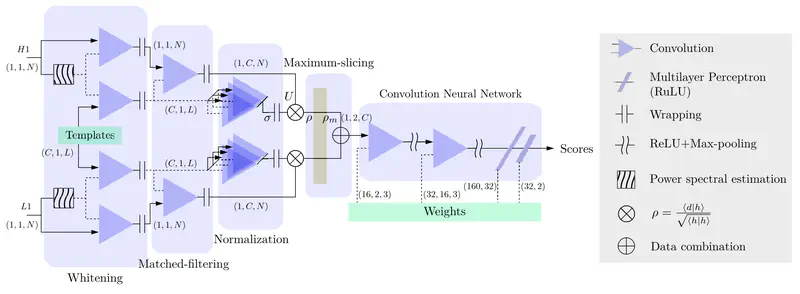
I study machine-learning searches in ground-based observations and simulated space-based data. Learned representations and waveform-informed filters provide ways to identify candidate events, with performance assessed against established search methods.
The work spans real LIGO observations and simulated massive-black-hole-binary signals for LISA. Shared benchmarks test generalization and false-alarm control. I also investigate searches for exotic gravitational-wave signals beyond general relativity.
- Waveform-informed networks
- Search benchmarks
- False-alarm control
Denoising & reconstruction
How much of a signal can we reconstruct when detector noise changes over time?
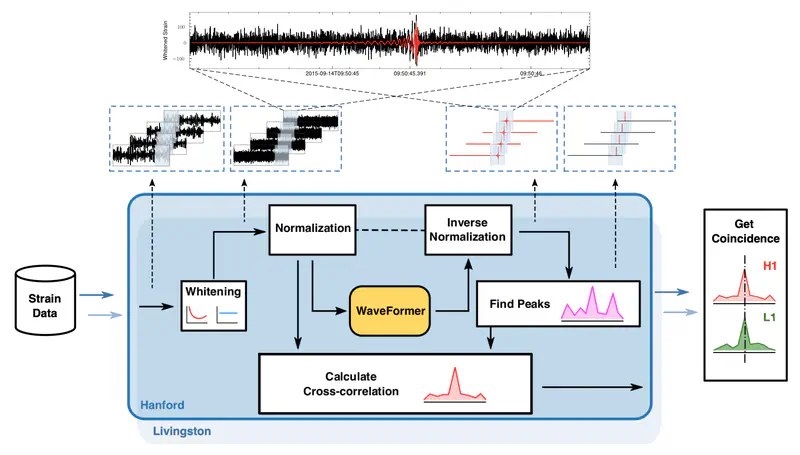
I work on reconstructing gravitational-wave signals from contaminated strain data. This includes transformer-based denoising and neural extraction of massive-black-hole-binary signals in simulated space-based observations.
Tests include glitches, gaps, and changing noise correlations. I examine reconstruction quality across these conditions to understand when learned denoising can provide useful inputs for subsequent physical inference.
- Transformers
- Signal reconstruction
- Non-stationary noise
Bayesian & simulation-based inference
How can we estimate physical parameters quickly while checking the uncertainty in those estimates?
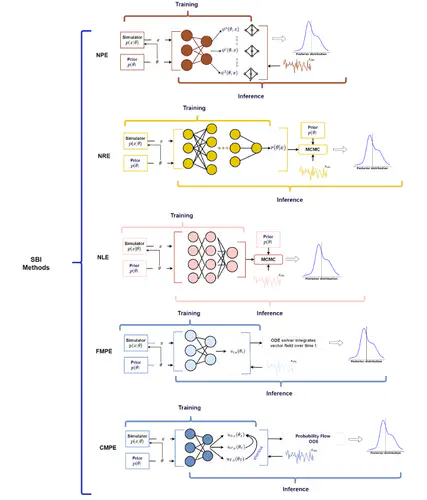
I work on Bayesian and simulation-based inference for massive-black-hole binaries and extreme-mass-ratio inspirals. Normalizing flows, flow matching, and hybrid Monte Carlo methods help explore posteriors; I compare their outputs with conventional analyses and test their response to noise.
My SBI review brings these methods together, from neural posterior, likelihood, and ratio estimation to flow matching. Related work treats instrumental noise as an inferred quantity, propagating uncertainty from foreground subtraction into the noise spectrum.
- Normalizing flows
- Flow matching
- Hybrid Monte Carlo
Scientific discovery with LLMs
How can language models help construct executable algorithms that can be evaluated and inspected?
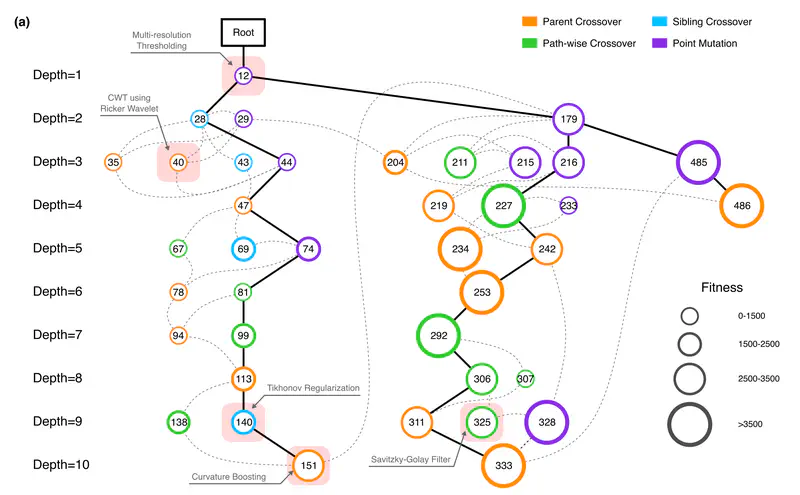
I explore language models as generators of executable scientific algorithms. Evo-MCTS combines generated code with evolutionary tree search, using gravitational-wave detection as a case study.
G-LNS studies the co-evolution of destroy and repair operators for combinatorial optimization. Both projects evaluate candidate methods on defined computational tasks, making their performance and algorithmic structure available for inspection.
- Language models
- Evolutionary search
- Executable algorithms
Representative papers